

Joining a youth soccer academy in the United States can involve scouting, an application, an invitation to train or a tryout. The route depends on the program. Professional club academies are highly selective, while independent clubs may hold seasonal evaluations. Because “academy” can also describe a local training business, families need to understand what each program offers before applying.
This guide explains the main types of youth soccer academy, how players are recruited and what families should prepare. It also covers eligibility, costs and how to verify an opportunity. No academy place is guaranteed, but understanding the process helps you choose a realistic route for your child.

What is a youth soccer academy
A youth soccer academy is a development program that may prepare players for higher levels of the game, including professional, college or national team pathways. Selective programs often provide specialized coaching and demanding competition. However, the name alone does not establish the standard: check the coaching, league, training schedule and selection process.
Because the term is used loosely, it helps to separate the main options families will come across.
| Option | What it is | How players join | Typical cost structure |
| Academy | A selective development program, often linked to a professional club or an elite league | Scouting, invitation-only trials or a formal application | Varies: some MLS academies are free-to-play; many others charge fees |
| Competitive club (travel or club soccer) | Teams that compete in regional or national leagues | Tryouts or evaluations, often held each season | Usually annual club fees, plus travel |
| Recreational league | Local, community soccer focused on participation and enjoyment | Open registration | Lower fees |
| Camp, clinic or ID event | A short program for training or player identification | Open registration, sometimes with selection | Paid per event |
A camp or ID event can be valuable, but it is not the same as joining an academy, and attending one does not guarantee a trial or a place.
The main types of youth soccer academy in the USA
MLS club academies
Every Major League Soccer club runs an academy designed to develop players for its professional team. MLS academies typically field full-time academy teams in the older age groups and run part-time or pre-academy programs for younger players, who often train with the academy while continuing to play for their home club. These academies are highly selective and recruit mainly through scouting.
Each MLS club has its own processes, age groups and recruitment events, so always check the club's official academy page. Our club guides explain how players enter the New York Red Bulls Academy, LA Galaxy Academy, FC Dallas Academy and Atlanta United Academy.
Independent elite clubs
Beyond MLS clubs, many independent clubs compete in elite youth leagues such as MLS NEXT, ECNL and Girls Academy. These clubs can offer a high standard of coaching and competition, strong college exposure and, for some players, a route to being noticed by professional academies. Most independent clubs charge fees, although some offer financial aid. Our guide to Youth Soccer Leagues in the USA: MLS NEXT, ECNL and Girls Academy Explained compares these leagues in detail.
Private and residential soccer academies
Some programs combine soccer with schooling, sometimes with boarding. These include private soccer academies and school-based programs that offer daily training alongside academic study. They can suit players who want a structured environment and education built around their soccer, but they are usually fee-paying, and the quality, competition and outcomes vary widely. Not every program that calls itself an academy offers the same level of coaching or exposure, so families should ask detailed questions before committing.
Identification programs
Identification programs help players get seen beyond their own club. The best known are the US Youth Soccer Olympic Development Program (ODP) and US Club Soccer's id2 program. These are not academies in themselves, but they can raise a player's profile and provide experience at a higher level. Our guide to the US Youth Soccer Olympic Development Program explains how ODP selection works.
How players get into a youth soccer academy
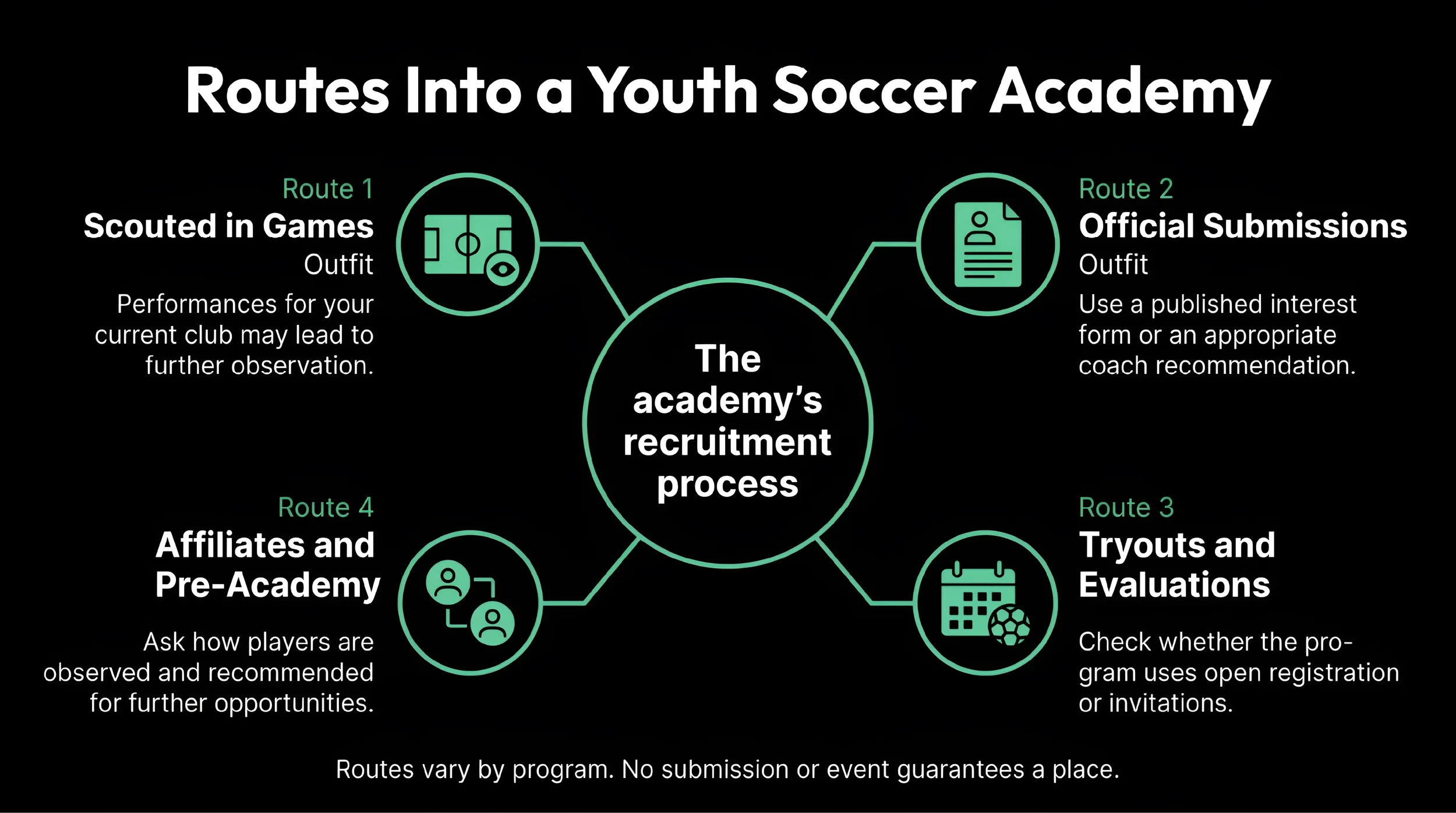
Being scouted while playing for your club
Consistent performances for a current club can help a player attract attention at matches, tournaments and showcases. Communication rules vary by academy. For example, D.C. United’s recruitment guidance says its scouts contact a player’s current club first and do not approach players or parents on the field. Follow the process published by the club you are interested in.
Invitation-only trials and recruitment events
An academy may invite a player to one session, several team practices or a longer trial. Some also hold recruitment events for invited players. Columbus Crew’s recruitment page, for example, describes scouting, trial invitations and invitation-only events, and states that the academy holds no open tryouts. Check the individual club rather than assume the same process applies everywhere.
Interest forms and recruitment submissions
Where an academy publishes an interest or recruitment form, use it to submit accurate player information and any requested footage. Some clubs also let families request scouting at an upcoming match. A submission does not guarantee a response or invitation. Your child’s coach or club director may also be able to make a recommendation through the appropriate channel.
Open tryouts and ID sessions: where they really exist
Open tryouts are more common at independent clubs and competitive club teams, often before a new season. Other clubs ask players to apply before inviting them to a training evaluation. ID sessions may use open registration or prior selection, so check the event’s eligibility and format.
Before attending any tryout or ID session, check who is running it, whether it is listed on the club's official website and what happens to players who impress. A paid ID event can be useful experience, but it is not a guaranteed route into an academy.
Moving up through affiliates and pre-academy programs
Many MLS clubs work with local youth clubs as affiliates, and some run pre-academy or development programs for younger age groups. These programs can act as a stepping stone, giving academy coaches a chance to watch players develop over time. If your player's club is an academy affiliate, ask the club director how players are recommended to the academy.
Age location and eligibility
Age groups vary by academy and league. MLS NEXT’s 2026–27 season overview describes six competition age groups from U13 to U19, but that does not mean every academy offers all six. Some professional clubs also run younger development programs. Check the club’s current teams and birth-date criteria before applying.
Start with programs within a workable travel distance, then ask about location and registration requirements. MLS academy recruitment can be affected by league rules, including Homegrown recruitment provisions, so a player should not assume they can join any club simply by relocating. Confirm the rules for your child’s age and circumstances directly with the academy.
International families should be aware that FIFA's rules on the international transfer of players under 18 limit how young players can register with clubs in another country, with only specific exceptions. Rules and visa requirements depend on each family's circumstances, so always seek advice from the club, the relevant soccer authorities and an immigration specialist. Our guide to UK Football Academies vs Overseas Options explains how these rules apply to international players.
What academy coaches and scouts look for
Academy coaches look for potential as much as current ability. Technical quality, such as first touch, passing and comfort on the ball under pressure, is a starting point. Tactical understanding matters too: how a player reads the game, makes decisions and positions themselves without the ball.
Players develop physically at different rates, so size and speed need context. Coaches may also consider how a player responds to feedback, handles mistakes, works without the ball and communicates with teammates. Attitude supports development, but no single quality determines selection.
How to prepare for a soccer academy trial
The best preparation starts weeks before the trial. Keep playing regularly at the right level, focus on the basics of your game and build fitness gradually rather than cramming in extra sessions. Our guide to Football Fitness Training for Young Players Preparing for Academy Trials explains how to prepare physically and safely.
In the days before, prioritize sleep, regular meals and light training, so the player arrives fresh. Check the time, location and what to bring, which usually includes cleats for the right surface, shin guards, water and weather-appropriate clothing. Arrive early, introduce yourself to the coaches and listen carefully to instructions.
During the trial, players should use their strengths, communicate with teammates and stay involved without the ball. After a mistake, the next useful action matters more than trying to make up for it immediately. Encourage your child to listen, keep working and make decisions that help the team.
How to contact a youth soccer academy the right way
The best first step is the academy's official channel, usually a recruitment or interest form on the club's website. Keep any information short and accurate: the player's name, date of birth, position, current club and league, and contact details for a parent or guardian. If the form allows it, add a short highlight video and a link to full-match footage. Our guide on How to Write a Football CV for Academy Applications explains how to put together a clear player profile.
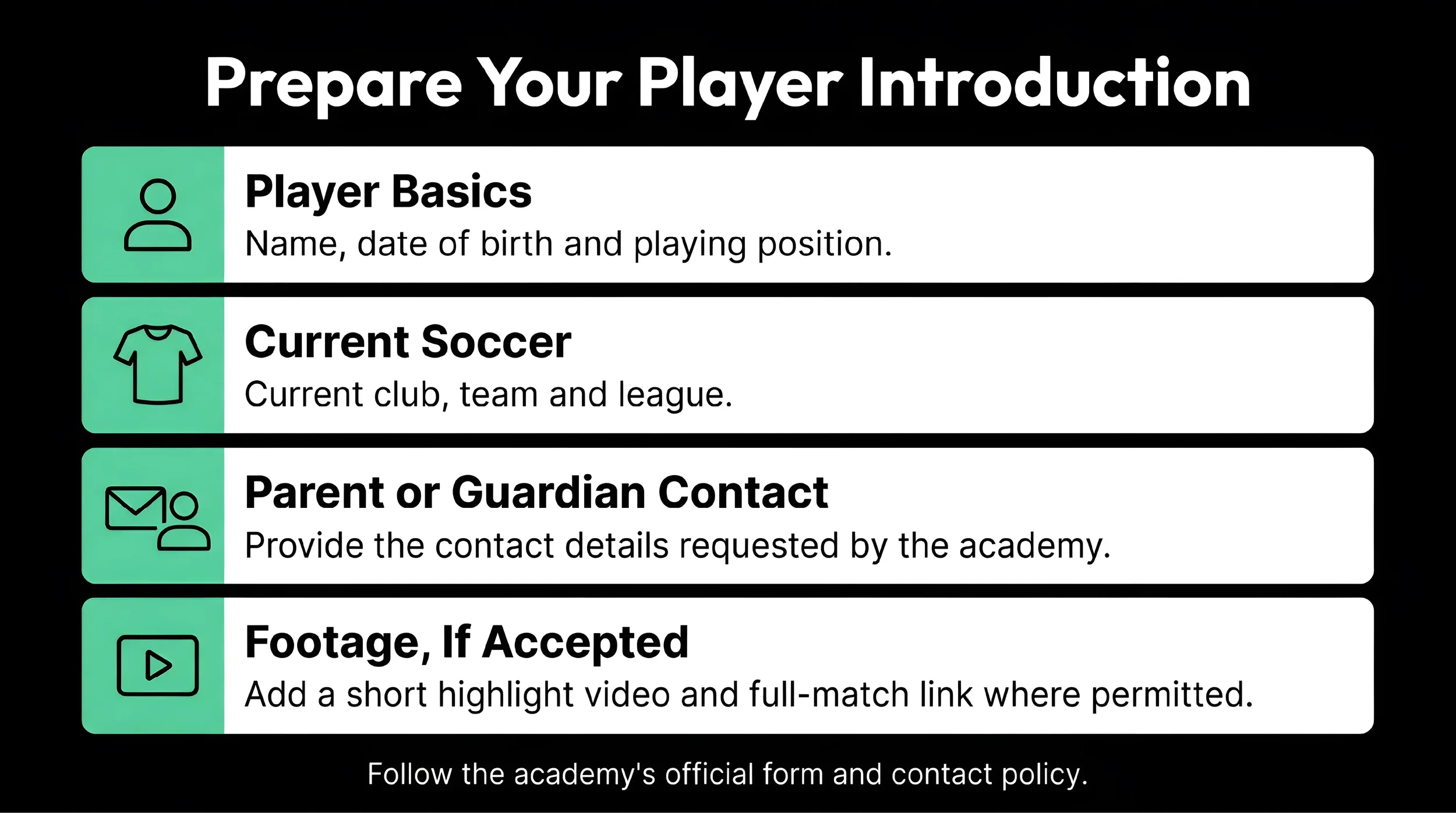
Ask your child’s coach whether a recommendation is appropriate and how it should be submitted. Follow the academy’s contact policy rather than emailing multiple staff members or seeking an on-field conversation. Some programs receive more submissions than they can answer, so keep developing and exploring suitable options while you wait.

Your future
starts
here
REGISTER
What does a youth soccer academy cost
Costs vary widely depending on the type of academy. Some MLS academies describe themselves as fully funded and free-to-play for players selected into their academy teams, although families should always check each club's own policy, and pre-academy or development programs may work differently.
Independent clubs in elite leagues usually charge annual fees, and some offer financial aid or scholarships. Private and residential programs are typically fee-paying and can be a significant investment, especially when boarding and schooling are included. Families should also budget for costs beyond fees, such as travel to matches and tournaments, uniforms, equipment and event entry. Before committing to any program, ask for a clear, written breakdown of what is included.
How to verify a trial or evaluation
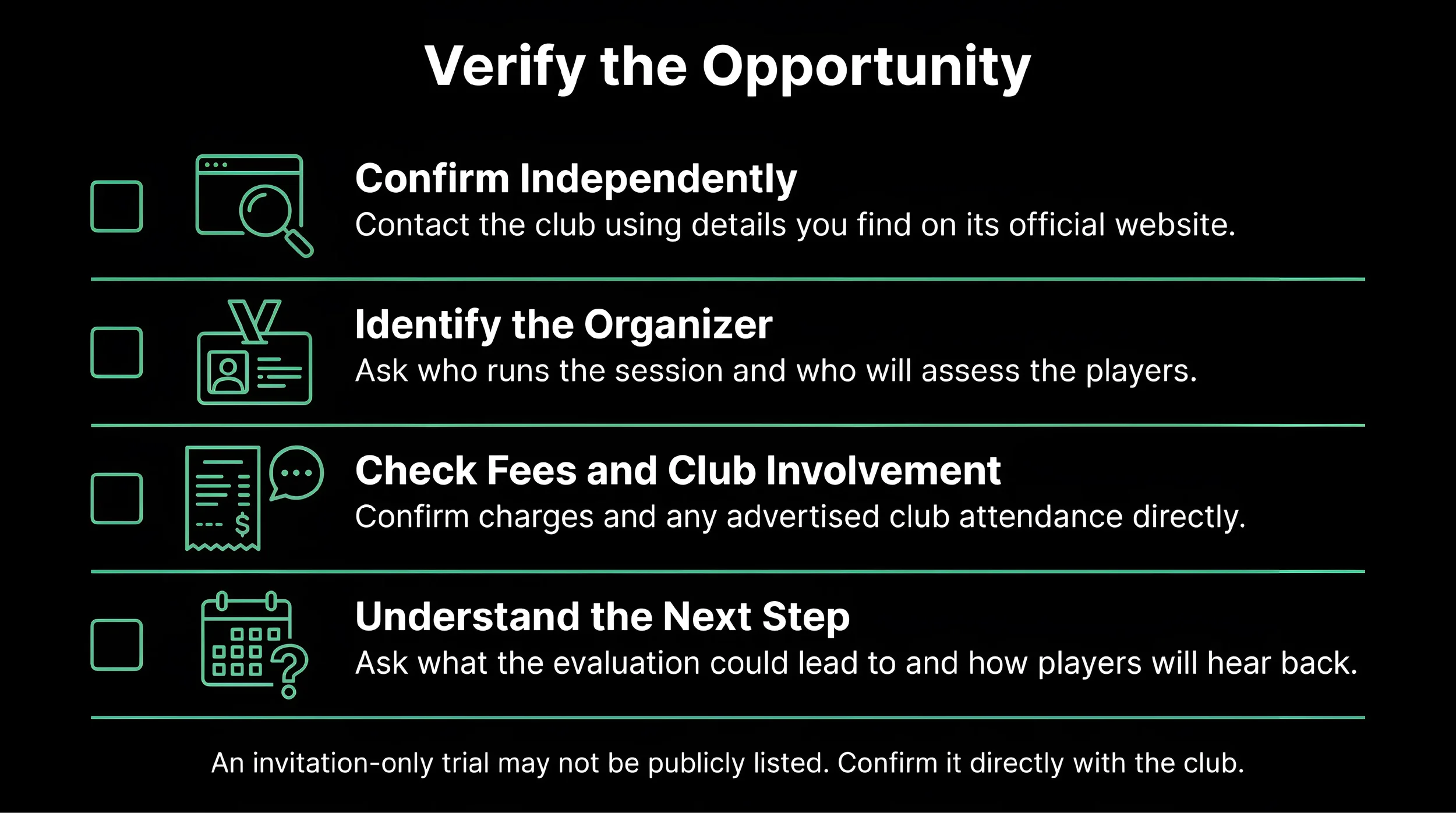
Because families are eager for opportunities, some people try to profit from the academy dream. Be cautious of anyone who promises a guaranteed trial or place at an MLS academy in exchange for payment, including private trainers who claim their sessions are a route into a specific club's academy. Some MLS academies warn publicly that people making such offers are not associated with them.
Verify the invitation through contact details you find independently on the club’s official website. An invitation-only trial may not have a public event listing. Check the organizer and staff, confirm any fee directly, and ask who will assess players and what the next steps could be. For a paid ID event, establish whether the advertised clubs have confirmed their involvement.
What happens after an academy trial
After a trial, there are several possible outcomes. A player may be invited back for further sessions or an extended trial, offered a place in an academy or pre-academy program, encouraged to keep developing and return later, or not selected at this stage. Academies may not give detailed feedback, but it is reasonable to ask politely whether any is available.
Not being selected is common and rarely the end of the road. Many players develop later, move to a different club or find success through other routes. Our guide to What Happens After Football Academy Trials? explains how to support a young player through each outcome.
A step-by-step guide to choosing the right route
Begin with your child’s current coach. Discuss their level, development priorities and whether a more demanding environment would provide suitable playing opportunities. Then shortlist nearby academies and elite clubs, checking their age groups, coaching, competition and recruitment process.
Use official interest forms where available and ask the coach or club director whether they can recommend your child. Choose tournaments, showcases or ID events for their relevance to the player’s stage, and confirm who will attend before paying.
Prepare for an invitation by maintaining normal training, allowing recovery and checking the practical details. Keep other suitable routes open so development does not depend on one trial. Before combining academy, club and high school soccer, check whether the relevant league permits it.
Other routes if an academy isn't the right fit yet
An academy is only one route to a high level of soccer. Many players develop through competitive club soccer and high school soccer, and our guide to High School Soccer vs Club Soccer explains the trade-offs. College soccer offers another strong pathway that combines playing with a degree, and our College Soccer Recruiting Timeline for US High School Players explains how recruiting works. For a wider view of every option, see Youth Soccer Pathways in the USA: High School, College and Professional Routes.
Some families also consider international programs that combine soccer with education. Our guides to Soccer Academy in England for American Players and Summer Soccer Camps in England for US Teens explain what these options involve.
How AF Global can help
AF Global combines elite soccer development with education across the UK, Spain and the USA. Our Phoenix program in Arizona offers training and education for ambitious student-athletes, while our UK and Spain programs give players experience of the European game. AF Global graduates have gone on to earn scholarships at US colleges, alongside routes into professional and university soccer.
Our team looks at each player's soccer, education and goals, and can help you understand which route fits best. To find out more, register your interest.
Final thoughts
Choose programs that fit your child’s level, education and family circumstances. Check how each academy recruits, use its official channels and confirm the costs before committing. Keep the focus on regular learning and enjoyment while exploring opportunities. To discuss the options available through AF Global, register your interest with our team.
Frequently asked questions
-
No. Many MLS academies recruit only through scouting and invitation-only trials, and some state clearly that they hold no open tryouts. Open tryouts and ID sessions are more common at independent clubs and competitive club teams, so always check each academy's official website.
-
Yes. Club matches, tournaments and showcases can give scouts opportunities to observe players. Each academy sets its own recruitment and communication process, so follow its official guidance and ask your child’s current coach how they can help.
-
Prepare a short player profile with name, date of birth, position, current club and league, and a parent's contact details. A brief highlight video and full-match footage help. Use the academy's official interest form where one exists, and ask your club coach whether they can recommend you.
-
Verify the invitation with the academy using contact details found independently on its official website. Check the organizer, staff, location and any payment request. A private trial invitation does not need to appear as a public event, but the academy should be able to confirm it.
-
An invitation may follow scouting, a coach recommendation or a recruitment submission. An open tryout generally allows eligible players to register without a prior invitation, although age and other restrictions can apply. Check the club’s process before attending.
-
Ask who runs the event, who will be watching, what happens to players who impress and whether past participants have progressed. Be wary of any event that promises a guaranteed trial or academy place in exchange for payment.
-
Some MLS academies describe themselves as fully funded and free-to-play for players selected into their academy teams. Policies vary between clubs and programs, so check each club's official information. Independent clubs and private academies usually charge fees.
-
The club decides which ages it recruits. MLS NEXT’s 2026 – 27 competition spans U13 to U19, but individual academies may offer fewer teams or younger development programs. Check the current academy page and birth-date requirements.