

The Atlanta United academy is one of the most talked-about youth programs in MLS, and families often ask the same question: how does a player actually get in? The short answer is that the academy is free for players it selects, and those players are found through scouting. Around it, the club runs camps, the Regional Development School (RDS) and the invite-only Futures Program. Each plays a different role, and none of them guarantees a place.
This guide explains how the pathway fits together, what the Futures Program is (and isn't), how RDS tryouts work, how the club scouts players and where Atlanta United 2 fits in, along with cost, college and options for families outside Atlanta. For the wider picture of how MLS and other academies select players, start with our guide on How to Join a Youth Soccer Academy in the USA.
How the Atlanta United Academy pathway fits together
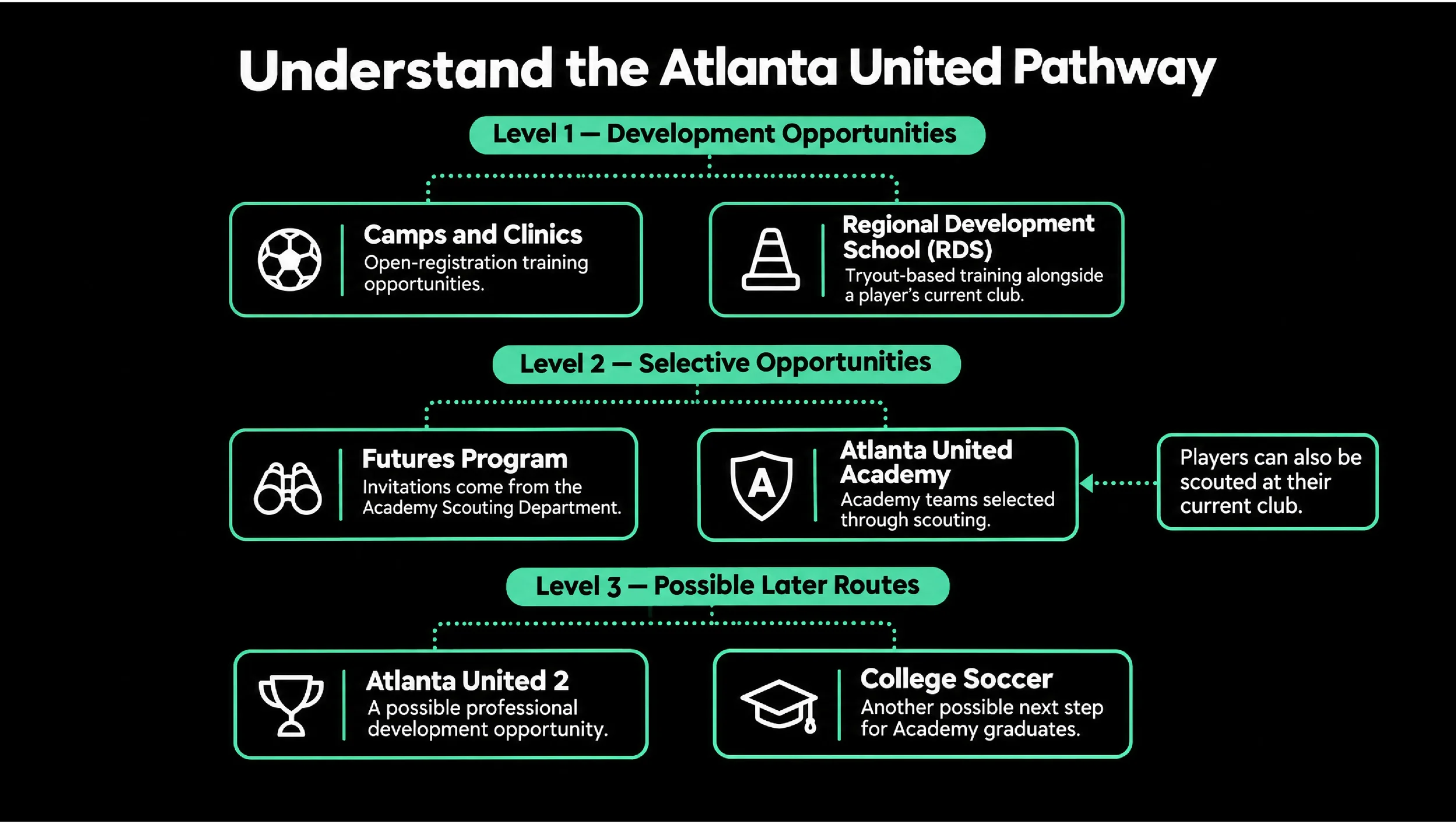
The club's information is spread across separate pages for the academy, RDS and Futures. Put together, the pathway usually looks like this:
Camps and clinics: open-registration programs for younger players.
Regional Development School (RDS): tryout-based weekly training that the club calls "the first step on that pathway."
Futures Program: weekly sessions with Atlanta United staff for boys invited by the academy scouting department.
Atlanta United Academy: full academy teams competing in MLS NEXT.
Atlanta United 2 (ATL UTD 2): the club's MLS NEXT Pro team.
Homegrown contract and first team: the end goal for a small number of players.
Players do not have to pass through every step in order. A player can be scouted at their club without attending RDS, and being in RDS or Futures does not mean the academy will follow. Professional soccer is also only one outcome: the club says 95 of its academy graduates have moved on to NCAA Division I programs. For a broader view of how MLS pathways compare, see our guides on How to Join a Youth Soccer Academy in the USA and Youth Soccer Pathways in the USA: High School, College and Professional Routes.
Atlanta United Academy teams and age groups
The Atlanta United academy launched in 2016. It trains and competes out of the Children's Healthcare of Atlanta Training Ground in Marietta, Georgia, the same facility used by the first team and ATL UTD 2.
Check age groups carefully, because the club's own pages do not match. The academy's About page lists teams at U-13, U-14, U-15, U-17 and U-19, while the team menu shows rosters for U-13, U-14, U-15, U-16 and U-18. The current Atlanta United academy roster pages and the club's MLS NEXT schedule are the best guide to which teams exist right now.
For how academy teams compare with other clubs in the same league, our guides to MLS NEXT Academy Division vs Homegrown Division and Youth Soccer Leagues in the USA: MLS NEXT, ECNL and Girls Academy Explained explain the league structure in more detail.
The Atlanta United Futures Program: what it is and what it isn't
The Futures Program is the part of the pathway families most often misunderstand. It sits between club soccer and the academy, but a Futures place is not academy selection.
Who the Futures Program Is For
The club launched the Futures Program in 2023 for boys ages 11 to 14. Players attend one session a week with Atlanta United staff through the fall and spring at the Training Ground in Marietta. Importantly, the club says players keep their own club team upon selection, so Futures is designed to add to a player's development rather than replace their current environment.
How Atlanta United Futures Invitations Work
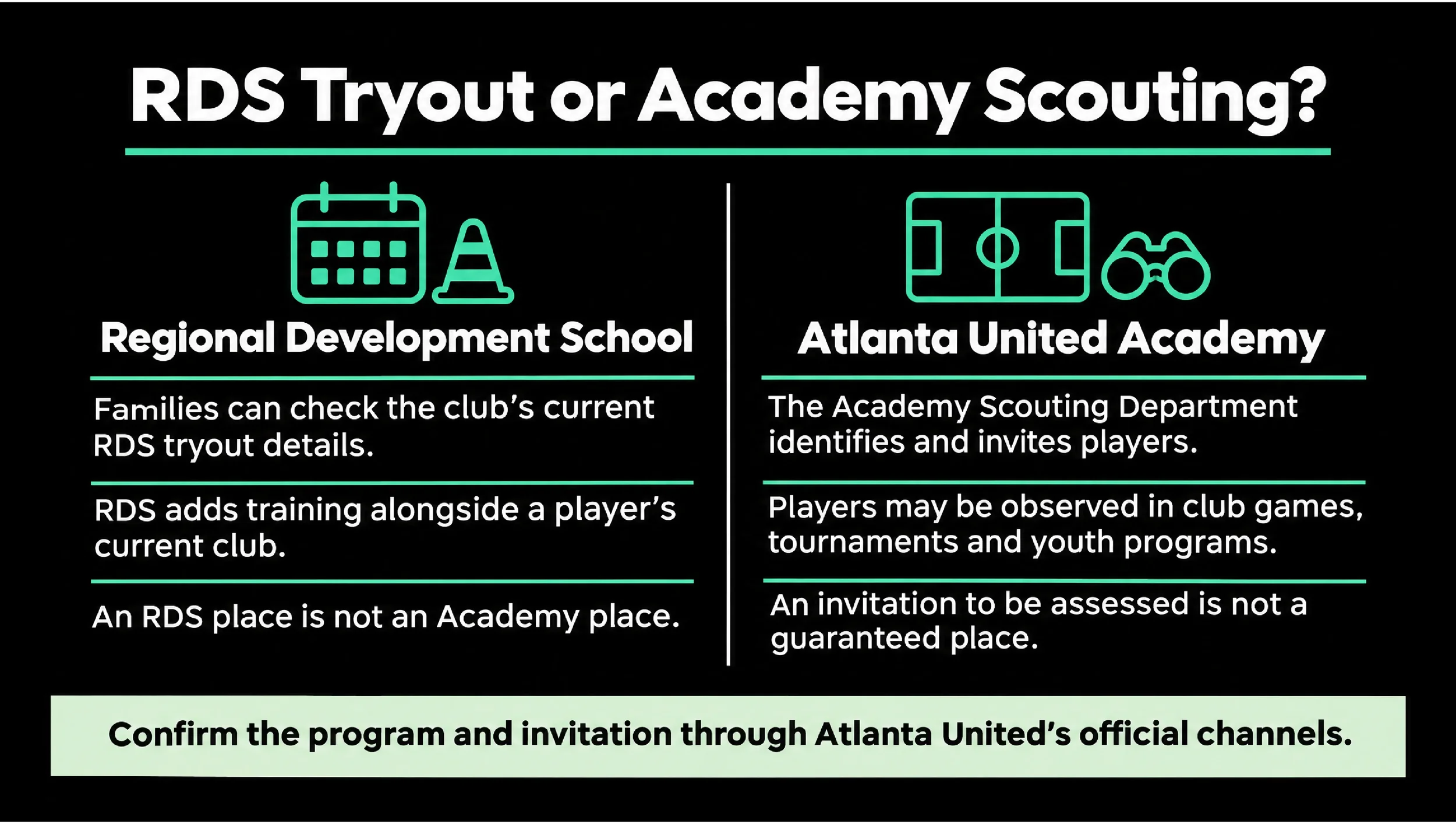
The club's youth FAQ is clear that the Futures Program is invite-only, and that all invitations come from the ATL UTD Academy Scouting Department. RDS coaches can recommend players at the end of each season, but the FAQ also states that RDS Player Evaluations are not used for Futures or academy recommendations. In other words, a good RDS evaluation report is useful feedback, but it is not an application.
The Futures page lists contact details and an interest form for questions, but contacting the club will not by itself lead to an invitation.
Futures vs the Academy
Futures and the academy are separate programs. Futures gives younger players regular Atlanta United coaching and gives scouts more time to watch them develop, while the academy is the club's full program competing in MLS NEXT. Some Futures players may later be invited into the academy, but the club does not present Futures as a guaranteed route in. The Futures page also does not publish a cost, so families who receive an invitation should ask the club directly what, if anything, is charged.
Atlanta United RDS: the Regional Development School
For most families, the Regional Development School is the one part of the pathway they can apply for directly. The club describes RDS as tryout-based and "supplemental to a player's current training environment," meaning players continue with their own clubs while attending.
According to the club's RDS page and youth FAQ, players ages 7 to 14 can sign up for the tryout process, with girls eligible up to age 16. Another club youth page lists boys up to 15, so check the current RDS page before registering. Players must try out every season, even if they made the program before, and each tryout is for a specific location. Sessions run weekly for 90 minutes in fall, winter and spring blocks.
To secure a tryout spot, the club places a $25 credit card hold. The RDS page does not list the full program fee, so ask the club about costs before you commit. Players who attend at least half of a season's sessions receive an RDS Player Evaluation within four weeks of the program closing. RDS is a genuine chance to train within the Atlanta United system, but it is best seen as development first and exposure second.

Your future
starts
here
REGISTER
Are there Atlanta United Academy tryouts? How scouting works
Families searching for Atlanta United academy tryouts will find RDS tryouts on the club's website, but the club's academy and youth pages do not describe any open tryout for the academy itself. Academy selection runs through the scouting department, which also sends every Futures invitation.
Scouts can see players through RDS coach recommendations, Futures sessions, club matches, tournaments and MLS NEXT games. As with most MLS academies, playing consistently well for a good club is the foundation. Our cornerstone guide covers what scouts look for and how to prepare for a trial.
Be careful with paid events billed as an "Atlanta pro tryout" or "academy tryout." Private showcases are not Atlanta United trials unless the club itself lists them, so check the club's official website before paying anything.
From the academy to Atlanta United 2 and a Homegrown contract
Atlanta United 2 plays in MLS NEXT Pro and is the main bridge between the academy and the first team. The club describes the second team as "the preferred platform" for its academy players, and academy players regularly make their professional debuts there while still in the youth system. Our guide to MLS NEXT Pro Explained covers how the league works.
Two recent examples show what the route can look like. Goalkeeper Jonathan Ransom joined the academy in 2018 at U-12, made his ATL UTD 2 debut at 16 and signed a Homegrown contract with the first team in October 2025. Midfielder DD Sibrian signed with ATL UTD 2 through 2027, with a Homegrown contract set to take effect on July 1, 2028. The club has highlighted several other academy players who signed with ATL UTD 2 before becoming Homegrown players.
These examples are encouraging, but they are not typical. Only a small share of academy players sign professional contracts, so treat one as a possible result of a long development process, not the reason for joining.
Atlanta United Academy cost, school and college options
The club states that the Atlanta United academy is free for all selected players, and full-time players receive an equipment package that includes a full uniform and adidas footwear. Families should still budget for travel to the Training Ground.
The surrounding programs work differently. RDS uses a $25 hold to secure a tryout spot, but the full RDS fee is not published, and the Futures page does not mention cost. Ask the club for current figures before registering.
Education matters too. The academy says it supports players pursuing soccer at top colleges and universities across the United States. In April 2026, the club announced nine National Letter of Intent signings from its Class of 2026, eight of them to Division I programs, bringing its all-time total of academy graduates moving to Division I to 95. The club's pages we reviewed do not describe a school partnership, so ask how training fits around school. Our College Soccer Recruiting Timeline for US High School Players explains how recruiting works alongside academy soccer.
Joining Atlanta United Academy from outside Atlanta or abroad
The academy, Futures and RDS all operate in metro Atlanta. The club's pages we reviewed do not set out residency rules or Homegrown Territory boundaries, but regular weekly training means players need to live within reach. MLS clubs recruit mainly within their own regions, and league rules restrict how younger players move between territories.
International families face additional limits, including FIFA's rules on the international transfer of players under 18. These are covered in our cornerstone guide, and families should always seek advice from the club and an immigration specialist.
If an MLS academy isn't realistic because of location, there are other ways to combine serious soccer with education. AF Global is not affiliated with Atlanta United or any MLS club, but our Phoenix program in Phoenix, Arizona, combines training and education, and our UK programs give players experience of the European game.
Practical next steps for families
Make sure your player is in a well-coached, competitive club with regular minutes, because that is where scouts are most likely to see them. If they are in the right age range, consider an RDS tryout, and use the club's official contact details for questions about Futures. Check the current roster pages for age groups, and treat any paid event promising an Atlanta United trial with caution. Keep college and other routes open, so progress never depends on a single program. Our other club guides explain how the New York Red Bulls Academy, LA Galaxy Academy, FC Dallas Academy and Philadelphia Union Academy handle the same questions.
Final thoughts
Joining the Atlanta United academy is about being seen and invited over time, not passing a single tryout. RDS is the open door, Futures is an invite-only step for younger boys, and the academy and ATL UTD 2 sit at the top of the pathway. Understanding how these pieces connect helps families make informed decisions and avoid events that promise more than they deliver. When you're ready to explore your player's next step, register with AF Global.
Frequently asked questions
-
Atlanta United's academy scouting department identifies players and sends invitations. Scouts can see players through RDS coach recommendations, the Futures Program, club matches, tournaments and MLS NEXT games. The club's academy pages do not describe an open application route, so playing consistently well for a good club is the most important step.
-
They can be, but it is not automatic. The Futures Program is separate from the academy, and the club does not present it as academy selection. Futures gives younger players weekly sessions with Atlanta United staff and gives scouts more time to watch them develop. Any academy invitation still comes from the scouting department.
-
The academy is the club's youth development program, with teams competing in MLS NEXT. Atlanta United 2 is the club's professional second team in MLS NEXT Pro. The club calls ATL UTD 2 its preferred platform for academy players, and some make professional debuts there while still in the academy.
-
The club's Futures page says the program is for boys ages 11 to 14. It is invite-only, with all invitations coming from the ATL UTD Academy Scouting Department. Players attend one weekly session through the fall and spring and keep playing for their own club team. Check the club's page for current details.
-
The club's academy and youth pages do not describe an open tryout for the academy. The Regional Development School (RDS) runs tryouts each season, and RDS coaches can recommend players, but Futures and academy invitations come from the scouting department. Be cautious of paid events that claim to be Atlanta United academy trials.
-
The club states that the academy is free for all selected players, and full-time players receive an equipment package. Other programs work differently. RDS uses a $25 hold to secure a tryout spot, but the full RDS fee and any Futures cost are not published on those pages, so ask the club directly.