

UK Football Academies vs Overseas Options: A Guide for International Families
For international families, the question isn't just which football academy to choose. It's which country. England has the Premier League, a world-famous academy system and some of the best boarding schools anywhere. Spain has La Liga, a proud tradition of technical, possession-based football and academies that have produced some of the game's greatest players. And further afield, the United States offers a route that combines football with a university education.
Each option has real strengths, and each comes with practical hurdles around rules, language, schooling and cost. This guide compares a UK football academy with the main overseas options, explains the international rules that apply to young players wherever they go, and helps you decide which route best fits your child. If you're new to how academies work, our guide to What Is a Football Academy? is a good place to start.

The Rule That Applies Everywhere: FIFA and International Players Under 18
Before comparing countries, understand the distinction between training abroad and officially registering with a club. FIFA Article 19 generally restricts international transfers of players under 18, and related rules also cover certain first registrations of foreign minors. These protections apply across FIFA member associations, including England and Spain. A place at a school, private training programme or showcase is not, by itself, permission to register with a professional club.
FIFA permits narrowly defined exceptions, subject to the facts, documentation and required approval. Examples include parents moving for reasons unrelated to football, certain qualifying moves involving a player aged 16 to 18 and an EU or EEA country, and some cross-border situations. A family should not assume that a passport, residence permit, trial invitation or school enrolment establishes eligibility. Ask the relevant football association or club to assess the player’s specific case.
Brexit changed the UK position: English clubs cannot rely on the EU/EEA minor-transfer exception in the way clubs within the EU/EEA may be able to. Spain may therefore offer a route in some qualifying cases involving 16- or 17-year-olds, subject to the applicable exception and approval. EU or EEA nationality alone does not establish that a player can register with a Spanish club.
For many international families, official registration with a professional club abroad before 18 is restricted. A separate option may be to study at a school or college while taking part in a suitable football programme. Training, trials, friendly fixtures and official club registration are different activities. Turning 18 removes the minor-transfer barrier but does not automatically secure a club place, registration, immigration permission or the right to work as a professional player. The remainder of this guide compares educational football programmes as well as the wider club environments in the UK and Spain.
Official guidance for families: FIFA minor applications and The FA international clearance.
Why Families Choose a UK Football Academy
England offers a deep football ecosystem, from the Premier League and EFL to local clubs and school programmes. A suitable programme may offer strong competition and opportunities for players to be seen, but neither the country nor a school place guarantees regular minutes, scouting access or recruitment. Ask which teams your child will actually play for and at what level.
Education is another attraction. UK independent schools may offer GCSEs, A-Levels or the International Baccalaureate, depending on the institution. Some build football into the school timetable, allowing families to compare the academic curriculum, coaching and pastoral support in one place. Check the actual school and qualifications on offer rather than assuming every UK football academy is a boarding school or includes the same academic pathway.
Language matters too. For players who already speak English, or want to improve it, studying in England removes a major barrier and builds a skill that is valuable in football and far beyond it.
The challenges are real, though. UK independent boarding can be expensive; private-school education and boarding fees have generally been subject to 20% VAT since January 2025. Travel, adaptation to a new culture and the restrictions on international club registration before 18 also deserve attention. We cover daily life, pastoral care and costs in detail in Residential Football Academies in England.
Why Families Consider Spain
Spain’s cantera tradition includes professional club systems such as those at Barcelona, Real Madrid, Atlético de Madrid and Villarreal. Some Spanish coaches emphasise technique, positional play and tactical understanding. The actual coaching style, playing time and competition level depend on the specific club or independent programme, so ask to see its training plan and fixtures.
Spain’s climate can make outdoor training easier through much of the year, although conditions vary by region and season. In some qualifying cases, its position within the EU/EEA may allow an international 16- or 17-year-old to register with a club under a FIFA exception. An EU/EEA passport alone does not establish eligibility; the individual case and approval matter.
Language is an important consideration. Coaching and daily life in many Spanish programmes happen in Spanish, although English-medium international schools and some bilingual programmes exist. Families should check the actual language used by coaches, teachers and welfare staff. Visa requirements depend on the player’s nationality and circumstances, while FIFA’s under-18 club registration rules must be considered separately.
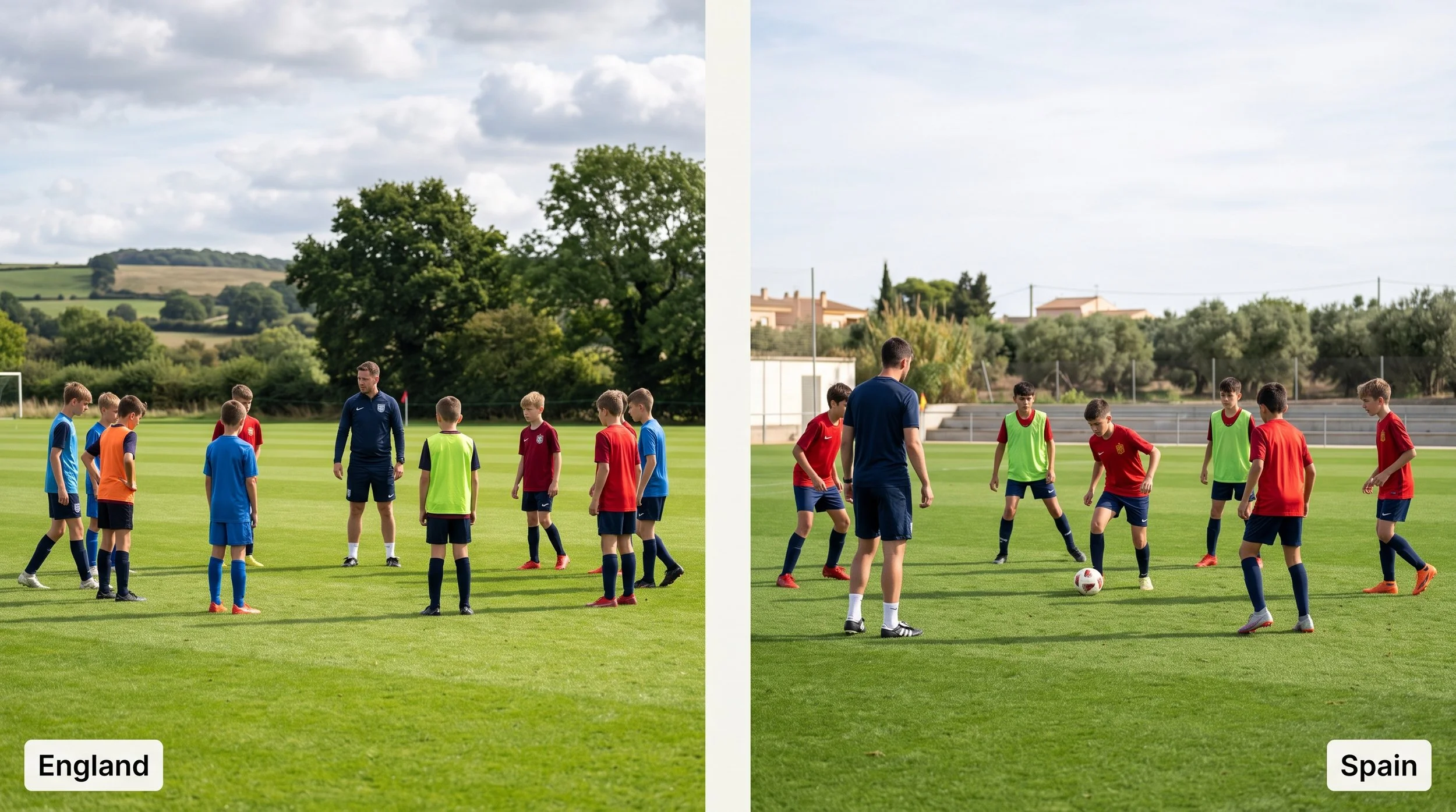
Families should also look carefully at how education and football fit together. In the UK, many football programmes are built into boarding schools, whereas in Spain, private academies often arrange schooling separately or partner with an international school. Ask exactly who is responsible for your child's education, accommodation and welfare. Our guide to the Best Football Academies in Madrid covers the Madrid options in more detail.
Other Overseas Options
Spain and England attract considerable interest, but they are not the only choices. Germany, the Netherlands and Portugal also have established football systems. Do not assume that every programme in a country offers the same language support, school curriculum, club access or playing time: assess the specific provider and the child’s ability to settle there.
The United States offers a different kind of pathway through university soccer alongside a degree. An athletic scholarship is possible, but admission, athletic eligibility and financial aid are separate decisions and are not guaranteed. Families considering this route should check the target college’s academic requirements and the applicable athletics eligibility rules, including any effect of previous football participation. A school’s US High School Diploma, where offered, is one possible academic route, not an automatic route to a scholarship.
UK vs Spain at a Glance
| UK programme | Spain programme | |
| Football style | Varies by club: technical, tactical and physical development | Varies by club: technical, tactical and physical development |
| Language | Usually English; check support for international students | Usually Spanish; bilingual options vary by programme |
| Education | School programmes may integrate GCSEs, A-Levels or IB; confirm the school | School provision may be integrated or arranged with a partner; confirm qualifications |
| Club registration before 18 | International transfers and certain first registrations of minors restricted; exceptions require assessment | Same FIFA restrictions; some EU/EEA-related cases may qualify from 16 with approval |
| Study permission | Check Child Student or Student eligibility by age and course | Check current Spanish study permission rules for the applicant |
| Climate | Varies by region and season; generally cooler | Varies by region and season; often warmer |
| Cost | Compare tuition, boarding, training, VAT and additional costs | Compare tuition, housing, training and additional costs |
Education, Language and Wellbeing
Whichever country you choose, compare the actual programme rather than its location or marketing name. A young player abroad needs suitable schooling, reliable care and a football environment with appropriate coaching, competitive minutes and feedback.
Education deserves particular attention. Ask which qualification the school will award, whether the child’s target universities will recognise it and how lessons fit around training. Some UK and Spanish programmes integrate schooling and football; others use separate providers. Check who is responsible for each part in writing.
Language affects everything, from understanding a coach's instructions to making friends. A child who can't communicate will find it harder to settle, and settling matters enormously for performance. If you're choosing a non-English-speaking country, ask what language support is provided, and consider whether your child is ready and willing to learn.
Welfare is the final piece. Ask who is responsible for your child day to day, what the supervision and safeguarding arrangements are, who acts as their guardian locally, and what happens during school holidays. A reputable programme will answer these questions clearly and in writing.

Visas and Practical Considerations
Families should check the relevant immigration route for their child’s nationality, age, course and school. In the UK, the Child Student route covers ages 4 to 17 at a licensed independent school. Some 16- and 17-year-olds may instead qualify for the Student route, depending on the course. The sponsor issues a Confirmation of Acceptance for Studies, and the application must include suitable care and living arrangements, including guardianship where applicable. For Spain, check current official consular guidance on study permission and arrangements for minors. Our UK Boarding Schools guide explains the school-application process in more detail.
Immigration and football-registration rules are separate and can change. A study visa allows study under its conditions; it does not itself authorise professional club registration or professional football employment. Check the current official visa guidance and ask the relevant football association about registration before paying for a place.
How to Choose Between a UK Academy and an Overseas Option
Start with your child’s long-term goal and current playing level. A UK school programme may suit a family looking for an English-language education alongside football. A particular Spanish programme may fit a player who is comfortable with its language, coaching and competitive environment. The availability of a club pathway for a minor must be assessed individually; an EU passport alone is not enough. If a university degree is the main goal, the US college route may be worth researching, subject to admission and athletics eligibility.
Then think about your child as a person. How independent are they? How would they cope with a new language and culture, far from home? A player who settles quickly and enjoys a new environment will develop far faster than one who is homesick and isolated, however good the coaching.
Finally, compare total cost and the precise arrangement on offer. Tuition, boarding, football, flights, visas, guardianship and holiday accommodation can all add up. Ask whether the offer is paid tuition, financial aid, a sports scholarship or an actual player contract: those are different arrangements. Get the complete breakdown in writing before comparing headline prices.
Questions to ask before choosing a programme
• Is this a registered professional club academy, a school football programme or an independent training provider?
• Which team and competition will the player join, and how are competitive minutes and progress reviewed?
• Who delivers education, accommodation, medical support and safeguarding, including during school holidays?
• What is included in the fee, and what evidence supports any claimed club pathway or showcase fixture?
• What language is used in coaching and school, and what support is available while the player settles?

AF Global: UK and Spain
AF Global presents football and education pathways connected to the UK and planned options in Spain. Families should check which locations are currently operating, which are accepting applications and what fixtures each programme actually offers. Do not assume that a private programme place includes registration with a professional club.
In England, AF Global London runs a football programme with a partner independent school. AF Global and its partner advertise a University of Hertfordshire football and degree pathway beginning in the 2027/28 season; confirm its start date and admissions status before publishing. The Spain locations are announced plans: Madrid and Barcelona. Confirm the separate launch dates and enrolment status rather than presenting them as operating academies.

Your future
starts
here
REGISTER
Final Thoughts
There is no universally better country for a young footballer. England, Spain and the US offer different combinations of clubs, schools and competition, but outcomes depend on the specific programme, the player’s opportunities to train and play, academic plans, language and welfare. Eligibility for club registration or a college scholarship must be assessed separately.
The right choice depends on your child's goals, language, personality and how well the programme looks after them on and off the pitch. If you'd like to talk through UK and Spanish options for your child, register your interest with AF Global. If London is on your shortlist, our guide to Choosing the Right Football Academy in London is a useful next step.
Frequently Asked Questions
-
Yes, an international player may be able to attend a UK school football programme if they meet its admissions and immigration requirements. Official club academy registration before 18 is a separate question governed by FIFA and FA rules, including possible exceptions. Turning 18 does not automatically secure registration, a place or professional work permission.
-
Neither is better for everyone. Compare the actual coaches, competition, playing time, qualifications, language and welfare support in each programme. The possibility of Spanish club registration for a 16- or 17-year-old depends on the specific FIFA exception and approval, not simply an EU passport.
-
English clubs cannot use the former EU/EEA exception to bring in an overseas minor merely because the player holds EU citizenship. Other FIFA exceptions may apply to a particular child, such as a genuine parental move for reasons unrelated to football, but the relevant authorities must assess the facts before club registration.
-
It helps a great deal. Some academies and international schools teach in English, but coaching and daily life often happen in Spanish. Players who learn the language usually settle faster and communicate better with coaches and team-mates.