

GOALKEEPER TRAINING FOR YOUNG FOOTBALLERS: CORE SKILLS AND PRACTICAL DRILLS
Goalkeeping is a specialist role with its own techniques, decisions and pressures. A goalkeeper may spend long spells with little to do, then need to make a vital save, organise a defence or start an attack in a single moment. Yet in many youth sessions, the goalkeeper simply stands in goal while outfield players practise shooting.
This guide explains the core skills every young goalkeeper needs and how to develop them safely, from the set position and handling to diving, positioning, distribution and communication. Each drill includes a set-up, how it works and the key coaching points, along with age guidance, common mistakes and advice on when specialist coaching helps.
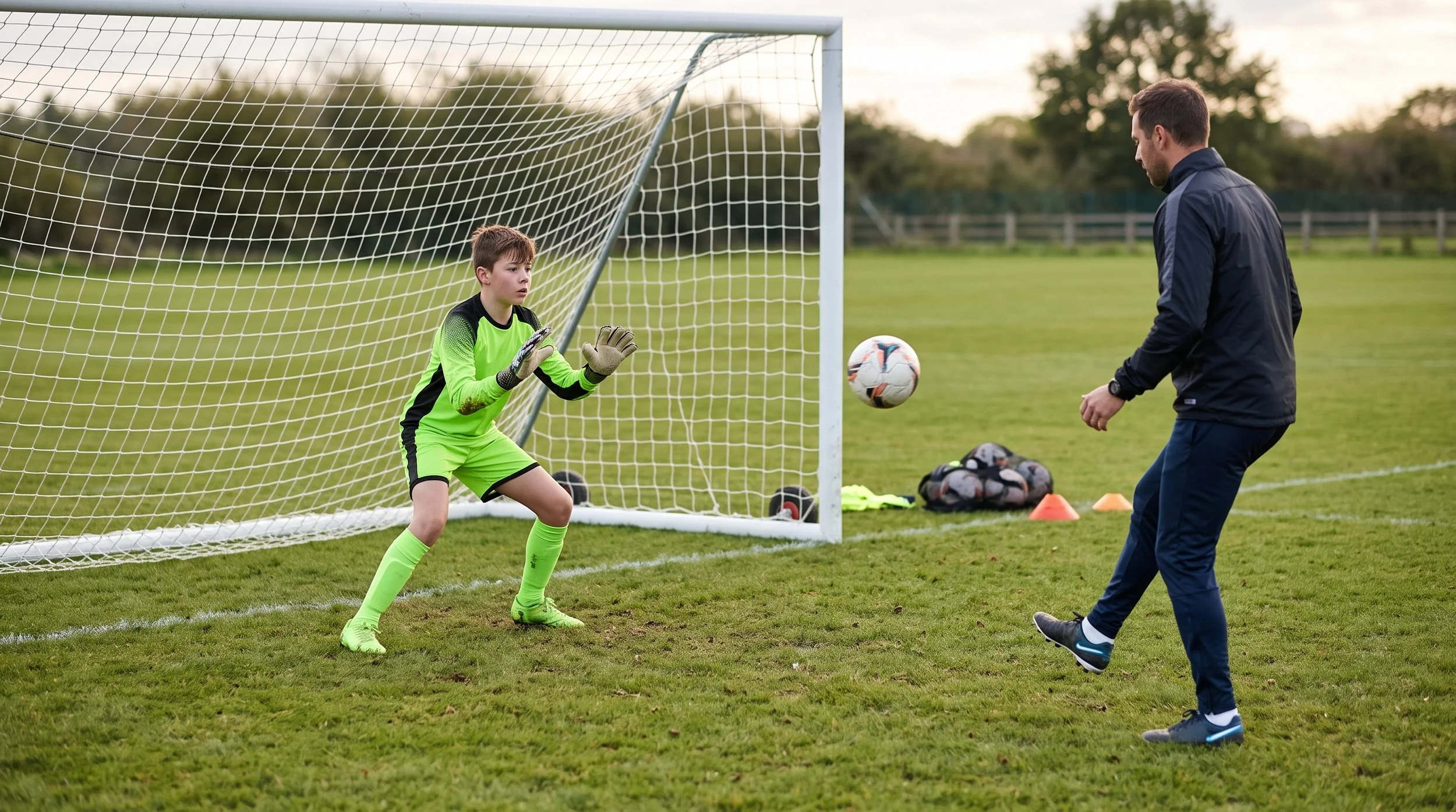
The Core Skills of a Young Goalkeeper
Every good goalkeeper builds on the same foundations. A strong set position allows them to react quickly to a shot. Good footwork gets them into position, often making a dive unnecessary. Safe handling means catching the ball cleanly at different heights. Diving technique, introduced gradually, allows them to reach shots they cannot get to on their feet. Positioning reduces the amount of goal an attacker can aim at. Distribution, with the hands and feet, turns a save into an attack. And communication helps organise the players in front of them.
The mental side matters too. Goalkeepers need concentration through quiet periods, courage to put their body in the way of the ball, and the resilience to bounce back from a goal that may not have been their fault. Coaches and parents can help by praising effort, good decisions and quick recovery after mistakes, rather than focusing only on goals conceded.
Safety First: Supervision, Surfaces and Shot Power
Goalkeeping involves diving, landing and facing hard shots, so safety should shape every session. Diving should be introduced and supervised by a qualified coach, who can teach correct landing technique and check that a goalkeeper is ready before progressing. Practise diving on soft, even surfaces, such as good grass or appropriate mats, and avoid hard or frozen ground.
Goalkeepers should wear properly fitting gloves and suitable clothing. Coaches should avoid powerful shots from very close range at young goalkeepers, rotate goalkeepers in shooting practices so no one faces too many shots, and finish sessions before fatigue affects technique. For physical preparation and warm-ups, see our guide to Football Fitness Training for Young Players Preparing for Academy Trials.
How to Use These Drills: Age and Progression
Goalkeeping skills should be built gradually, starting with handling and footwork and only adding more demanding dives and decisions as confidence and technique grow. The table below gives a starting point.
| Age group | Main focus | Diving | When to add pressure |
| U9 to U11 | Set position, catching, footwork and simple distribution, with lots of fun and variety | Kneeling and crouching dives only, under supervision | Mostly unopposed, with soft shots and small-sided games |
| U12 to U13 | Handling at different heights, positioning, low dives and distribution with both hands and feet | Crouching dives progressing to standing dives | Shots from different angles and simple decision-making |
| U14 to U18 | All core skills at match tempo, including 1v1s, high balls and playing out from the back | Full diving technique, under specialist coaching | Most practices realistic and opposed |
A starting guide only. Adapt to each goalkeeper's confidence, ability and stage of development.
Many coaches encourage younger players to try different positions, including goalkeeper, before they specialise. This builds all-round football skills and helps players discover where they enjoy playing most.
Set Position and Footwork Drills
Getting set
Set-up: A goalkeeper stands in goal, with a coach or server about eight to ten metres away.
How it works: The goalkeeper moves around the goal area. As the server prepares to strike, the goalkeeper gets into the set position and holds it until the ball is struck, then makes the save.
Coaching points: In the set position, the feet are about shoulder-width apart, the weight is on the front of the feet, the knees are slightly bent and the hands are relaxed in front of the body, ready to move. Being set as the ball is struck allows the goalkeeper to react in any direction. Moving at the moment of the shot is one of the most common reasons for conceding.
Footwork shuffle to save
Set-up: Place two cones about three metres apart on the goal line. A server stands about ten metres away.
How it works: The goalkeeper shuffles sideways between the cones, staying low and facing forward. On a signal, they get set and the server plays a shot within reach, which the goalkeeper saves on their feet.
Coaching points: Look for small, quick side-steps without crossing the feet, and the goalkeeper staying square to the ball. Good footwork often means a goalkeeper can reach a shot without needing to dive at all.
Catching and Handling Drills
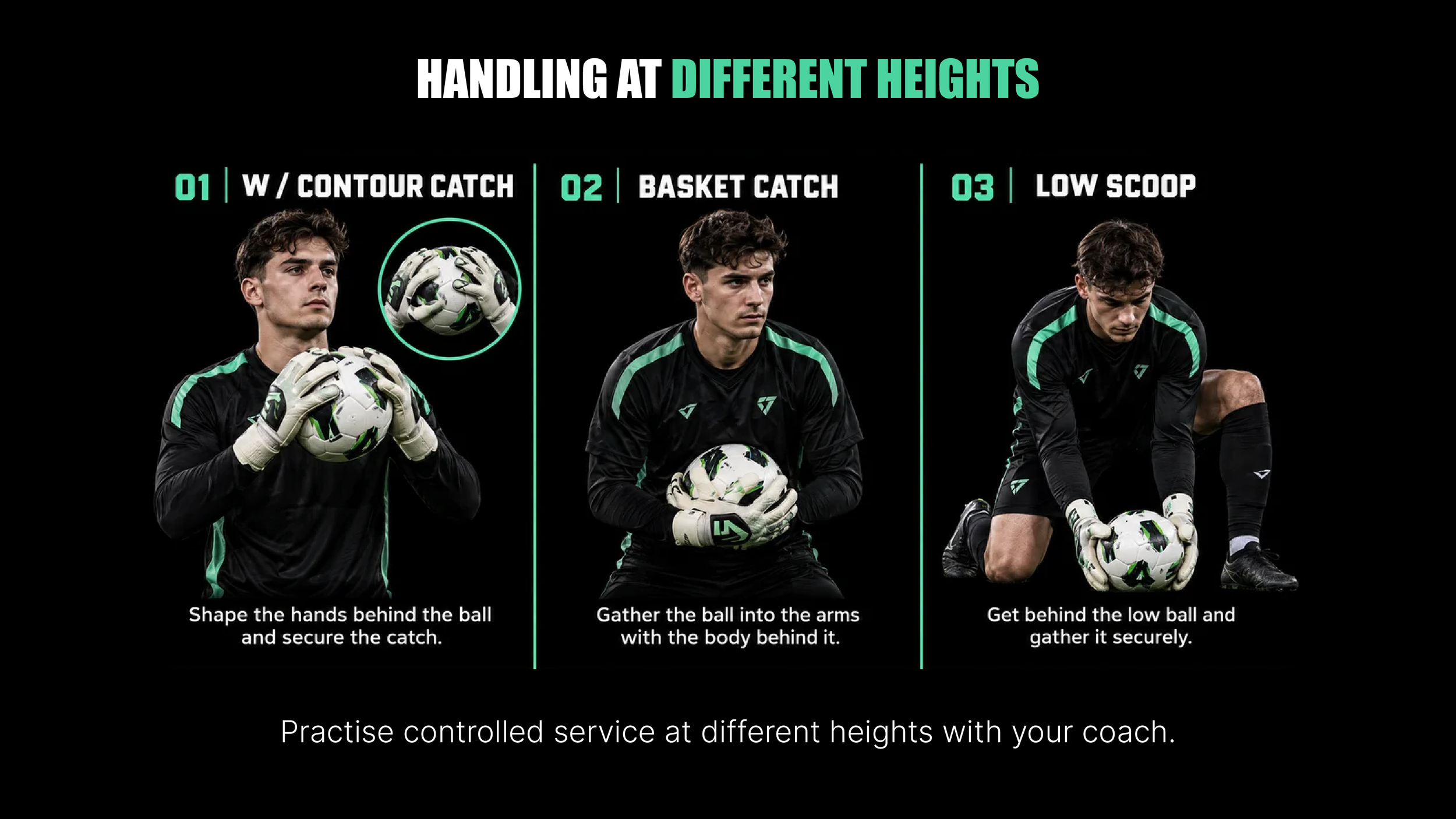
The W or contour catch
Set-up: A server stands about five metres from the goalkeeper with a ball.
How it works: The server throws or volleys the ball at chest height and above. The goalkeeper catches it with the hands forming a W shape behind the ball, thumbs almost touching.
Coaching points: The fingers should be spread and firm, and the hands should be behind the ball, not underneath it. Encourage the goalkeeper to bring the ball into the chest after catching it.
Basket and scoop catches
Set-up: As above, with the server rolling, bouncing or throwing the ball at stomach height and below.
How it works: For balls at stomach height, the goalkeeper forms a basket, with the arms and body wrapping around the ball. For low balls, they scoop the ball up, with the legs close together or one knee down behind the hands as a barrier.
Coaching points: Look for the body behind the ball, so there is a second barrier if the catch fails. Practise at different heights and speeds so goalkeepers learn which technique suits each ball.
Reaction handling
Set-up: A wall or rebounder, a goalkeeper and a server.
How it works: The server bounces or throws the ball off the wall or rebounder, and the goalkeeper catches the unpredictable rebound.
Coaching points: This drill sharpens reactions and handling. Keep the speed realistic for the goalkeeper's age and ability, and focus on clean, secure catches.
Safe Diving Progressions
Diving should always be introduced step by step, under the supervision of a qualified coach. Each stage should feel comfortable and controlled before moving on.
Diving from kneeling
Set-up: The goalkeeper kneels on soft ground, with a server about three to four metres away.
How it works: The server rolls or gently throws the ball just to one side. The goalkeeper falls sideways to catch it, landing on their side, with the ball held securely.
Coaching points: The goalkeeper should land on the side of the body, not on the elbow or stomach, with the hands reaching for the ball first and the ball pinned to the ground or brought into the body.
Diving from a crouch
Set-up: As above, with the goalkeeper in a low crouch.
How it works: The server plays the ball slightly further away, and the goalkeeper pushes off the nearest foot to make a low dive.
Coaching points: Look for the goalkeeper stepping towards the ball with the nearest foot and diving forwards or sideways, never backwards.
Diving from standing
Set-up: The goalkeeper in the set position on the goal line, with a server about eight metres away.
How it works: The server plays shots to either side at different heights, and the goalkeeper makes a full dive to save.
Coaching points: Before progressing to standing dives, a coach should check that landing technique is consistent and that the goalkeeper is confident. Shots should start at a manageable pace and build gradually.


Your future
starts
here
REGISTER
Positioning and Angles
Arc positioning drill
Set-up: Place five cones in an arc around the penalty area, about 12 to 16 metres from goal, with a ball on each.
How it works: A server moves to a cone and prepares to shoot. The goalkeeper adjusts their position so they are on an imaginary line between the ball and the centre of the goal, gets set and saves the shot. The server then moves to the next cone.
Coaching points: Good positioning reduces the amount of goal an attacker can see. Encourage the goalkeeper to move as the ball moves, stepping slightly off their line to narrow the angle, and to be set before every shot.
Shot-stopping from different angles
How it works: Outfield players shoot from different positions and distances while the goalkeeper adjusts their position and makes saves. Our guide to Football Shooting Drills for Young Players includes finishing practices that work well for goalkeepers too, as long as shot power suits their age.

Basic Decision-Making: Catch, Parry or Stay on Your Feet
Goalkeepers make decisions every time the ball comes towards them. As a rule, a goalkeeper should try to catch the ball when they can do so safely, because it ends the danger. When a shot is too powerful, awkward or wide to hold, parrying the ball away from goal and towards the side is safer than parrying it back into the danger area.
Staying on their feet as long as possible is another important decision. Goalkeepers who go to ground too early make it easier for attackers to lift the ball over them. In 1v1 situations, older goalkeepers learn to narrow the angle by moving towards the attacker, stay big and patient, and only commit when they can win the ball. Young goalkeepers should never be encouraged to dive head-first at an attacker's feet, and 1v1 practice should be carefully controlled by a coach. Dealing with high balls and crosses is best introduced to older goalkeepers once handling and positioning are secure.
Distribution Drills
With the hands
Set-up: Target zones or small goals placed at different distances from the goalkeeper.
How it works: The goalkeeper rolls the ball to targets at short distances, then progresses to overarm throws for longer distances.
Coaching points: Rolling suits short passes to a nearby defender. Overarm throws suit longer distribution. Look for the goalkeeper stepping towards the target and following through, and for accuracy before distance.
With the feet
Set-up: A defender, a goalkeeper and two target players or small gates.
How it works: The defender plays a back-pass to the goalkeeper, who takes a controlled first touch out of their feet and passes to a target. Progress to adding a pressing attacker.
Coaching points: Modern goalkeepers are expected to play with their feet, so first touch and passing matter. Encourage the goalkeeper to check their options before the ball arrives and to open their body to pass. Our guide to Football Passing Drills for Young Players covers passing and receiving technique in more detail. Goal kicks and kicking from the hands can be practised to targets at increasing distances, focusing on clean contact and accuracy.
Communication for Young Goalkeepers
Goalkeepers see the whole pitch in front of them, so they are well placed to help their teammates. Simple, clear calls make a big difference: "keeper" when claiming the ball, "away" to tell defenders to clear it, and "time" when a teammate has space. Older goalkeepers can also help organise defenders at set pieces. Communication is best practised in team activities, where coaches can encourage goalkeepers to talk early, clearly and positively.
Common Goalkeeping Mistakes
| Mistake | What it looks like | How to fix it |
| Not set when the shot is struck | The goalkeeper is still moving and cannot react | Practise getting set on the server's cue before every shot |
| Hands too far apart | The ball slips through the hands | Practise the W catch with thumbs almost touching |
| No body behind the ball | Low shots go through the legs or under the body | Practise basket and scoop catches with the body as a second barrier |
| Diving backwards | Saves are weak or the ball goes in | Step towards the ball with the nearest foot and dive forwards or sideways |
| Landing on the elbow or stomach | Painful landings and lost confidence | Return to kneeling dives and practise landing on the side |
| Poor starting position | Too much goal left for the attacker | Use the arc drill to practise moving with the ball |
| Distributing without looking | Passes and throws go to the opposition | Encourage a quick look at the options before receiving or releasing the ball |
When giving feedback, keep it short, specific and positive, and praise good decisions and technique even when a goal is conceded.
How to Measure Goalkeeper Progress
Goals conceded say more about the whole team than about the goalkeeper. A more useful picture includes how often the goalkeeper is set before shots, the percentage of clean catches, the quality of decisions to catch or parry, distribution accuracy with the hands and feet, and how well they communicate. Filming training and matches every few weeks is an easy way to review technique and decisions.
Why a Qualified Goalkeeper Coach Matters
Goalkeeping has its own techniques, and some, especially diving, carry a higher risk of injury if they are taught poorly. A specialist goalkeeper coach can introduce skills safely, correct technique early and plan sessions that match a goalkeeper's age and stage of development. England Football runs specific goalkeeping coaching courses, such as the UEFA B in Coaching Goalkeepers, so it is worth asking what qualifications a club's goalkeeper coach holds.
When choosing a club or academy, ask how often goalkeepers receive specialist coaching, how sessions are adapted for different ages, and how diving and 1v1 work is supervised. Our guide to What Is a Football Academy? Structure, Training and Career Outcomes explains what to expect from academy training more generally.
How AF Global Supports Goalkeepers
At AF Global, goalkeepers train as part of a full-time football and education programme with UEFA-licensed coaches, combining technical work with match experience and support for their wider development. To find out how AF Global could support your young goalkeeper, register your interest and our team will be in touch.
Final Thoughts
Good goalkeeper training builds the basics first: a strong set position, sharp footwork and secure handling. From there, diving, positioning, decision-making and distribution can be added step by step, under the supervision of a qualified coach. Keep sessions safe, varied and positive, and young goalkeepers will grow in confidence as well as ability. When you're ready to take the next step, register with AF Global.
Frequently Asked Questions
-
Young goalkeepers should start with the set position, footwork and handling, then build up to diving, positioning, distribution and communication. Developing these skills in that order helps goalkeepers stay safe and confident.
-
Being set as the ball is struck allows a goalkeeper to react quickly in any direction. Good footwork gets them into position early, which often means they can make a save on their feet rather than having to dive.
-
Start with catching at different heights using the W, basket and scoop techniques. Introduce diving from kneeling, then from a crouch and finally from standing, under a qualified coach, moving on only when landing technique is consistent.
-
Practise moving with the ball so the goalkeeper stays between the ball and the centre of the goal. Coaches can then add shots from different angles and simple situations where the goalkeeper decides whether to catch, parry or stay on their feet.
-
Use target zones for rolls and throws, and practise receiving back-passes and passing to teammates under gradually increasing pressure. Focus on accuracy and looking at the options before releasing the ball.
-
A qualified goalkeeper coach introduces techniques in the right order, teaches safe landing and supervises diving and 1v1 practice. They also adapt sessions to each goalkeeper's age and ability, so players progress safely.