

How to Write a Football CV for Academy Applications With a Copyable Template
Some independent academies, school football programmes, scholarship providers and showcase events ask for a short player profile or football CV. A parent may have to put one together before a programme can understand the player’s current level. The right details depend on what that particular application asks for.
A football CV helps a coach find the essentials quickly: age group, playing role, recent football experience, contact through a parent or guardian, and a video link if available and requested. It does not prove ability or guarantee a trial. This guide gives you a copyable template, a fictional example and checks for sharing a minor’s information safely. For the wider route into academies, see How To Join A Football Academy in The UK.

What Is a Football CV and When Do You Need One?
A football CV is a concise summary of a player’s current football profile. It explains who the player is, where they play, their experience and how a legitimate programme can contact the family. For young players, one clear page is usually enough. Some providers use an online form instead and do not ask for a separate CV.
A CV or player profile can help when an independent or residential academy, school programme, scholarship panel, showcase event or college pathway requests one. Follow that organisation’s application instructions: a form, school report, match footage and supporting documents may have separate requirements.
Professional club academies generally identify younger players through scouting and referrals in football settings. Some clubs announce their own observation or recruitment routes, but sending an unsolicited CV is not a reliable way to obtain a trial.
What to Include in a Football CV
Start with the information that explains the player’s current level, then add optional details only where the recipient asks for them. The template below shows a practical order.
Personal details
Include the player’s name, current age group or birth year, and a parent or guardian’s name, email and phone number for an under-18 player. Add the full date of birth, nationality or country of residence only if the verified programme needs it for eligibility or asks for it through an appropriate application channel.
A CV can be forwarded. Leave out the child’s home address, personal mobile number and public social-media handle. Do not put a passport number or other identity-document image in a general CV. Share more sensitive details only through a verified provider’s secure process when needed.
Player profile
Use two or three honest sentences about the player’s role and how they play. “A left-footed central midfielder who receives on the half-turn and looks to switch play” is more informative than “hard-working team player.” Include strengths you can show in matches. The player’s own voice is fine; there is no required third-person style.
Positions and preferred foot
List the main position first, then any secondary positions your child plays confidently, along with their preferred foot. Versatility is valued, but only include positions they have genuinely played.
Physical details
Height is optional for a young player. If a programme asks for it, use a current measurement with the month and year. Physical size changes during growth and should not be made the centre of the CV.
Playing history
List the current team and recent previous teams, seasons, age group and level of competition. School, district or county representation can be included where relevant, without naming the child’s current school in a CV that may be forwarded. Explain unfamiliar leagues or levels briefly, especially for an overseas recipient.
Statistics and achievements
Use only accurate, dated figures that the family or club can verify. Appearances and minutes or starts may help show involvement; goals and assists or clean sheets are relevant only with the player’s position and level of competition. If reliable statistics are unavailable, leave them out and describe the playing experience instead. Include a small number of meaningful selections or awards.
Education
For a school, scholarship or university application, include school year, relevant qualifications or predicted grades if requested. Share a full school report through the organisation’s official admissions channel rather than putting grades or the current school’s identifying details in every general football CV. International applicants can state the education system and English proficiency where relevant.
References
Ask a coach’s permission before naming them. One relevant coach is often enough; list their role and club, and provide their contact details to a verified recipient if the coach agrees. “Coach reference available on request” is suitable for a CV that may be widely forwarded.
Highlight video link
If the programme asks for footage, add a working link to recent clips that show the player’s position and a range of match actions. Keep it concise and easy to follow, but follow any duration or format specified by the recipient; there is no universal two-to-four-minute rule. Make the player identifiable without adding a full personal profile to the video. A full match can be offered on request.
Use an access-controlled or unlisted link only where filming and sharing the footage are permitted by the club, venue or competition. Check The FA’s safeguarding guidance and avoid identifying other children or linking images to detailed personal information. Test the link from a device that is not logged into your own account; some recipients cannot open restricted files.
Optional extras
For older applicants, a short statement about the specific programme may help. Leave detailed injury and medical history off a general CV; disclose necessary health information through the provider’s confidential process when it is requested for safe participation. Do not add an optional item merely to fill space.
Football CV Format and Layout
Aim for one page with readable headings and spacing. A second page is rarely needed for a youth application unless a provider asks for extra detail. A photo is optional and should not be placed on a public profile with identifying details about a child. Follow the recipient’s rules if an image is specifically required.
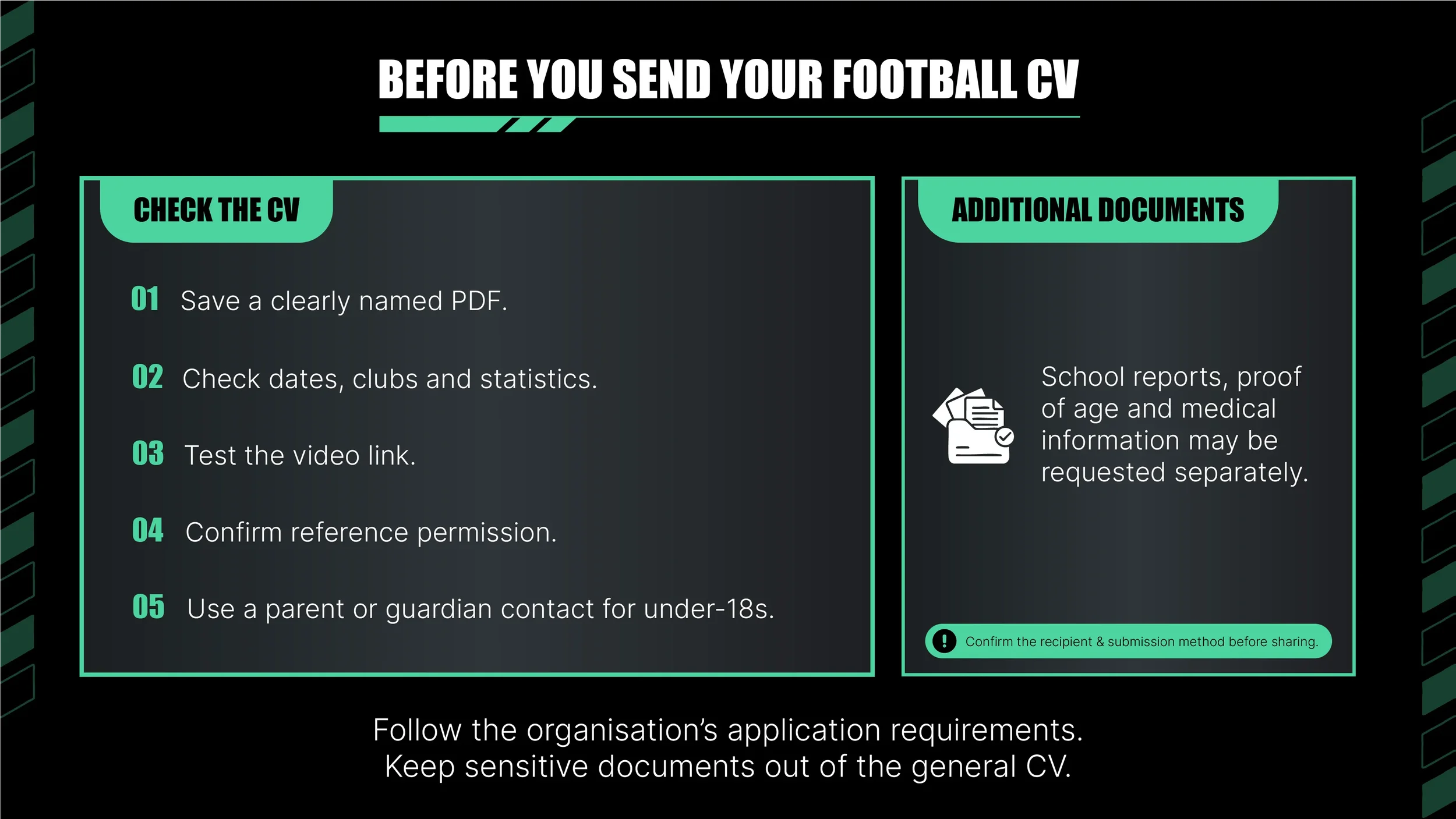
A PDF normally preserves the layout well, but use the format and upload channel the programme specifies. Name the file clearly, for example Sam-Taylor-Football-CV-2026-27.pdf. Check that the document opens on a phone, that the video link works, and that age group, current club and contact details are up to date before each application.
Before sending, open the final PDF yourself, click the video link from a private browser window, check the recipient’s official contact details and keep a copy of the version you submitted.
Free Football CV Template
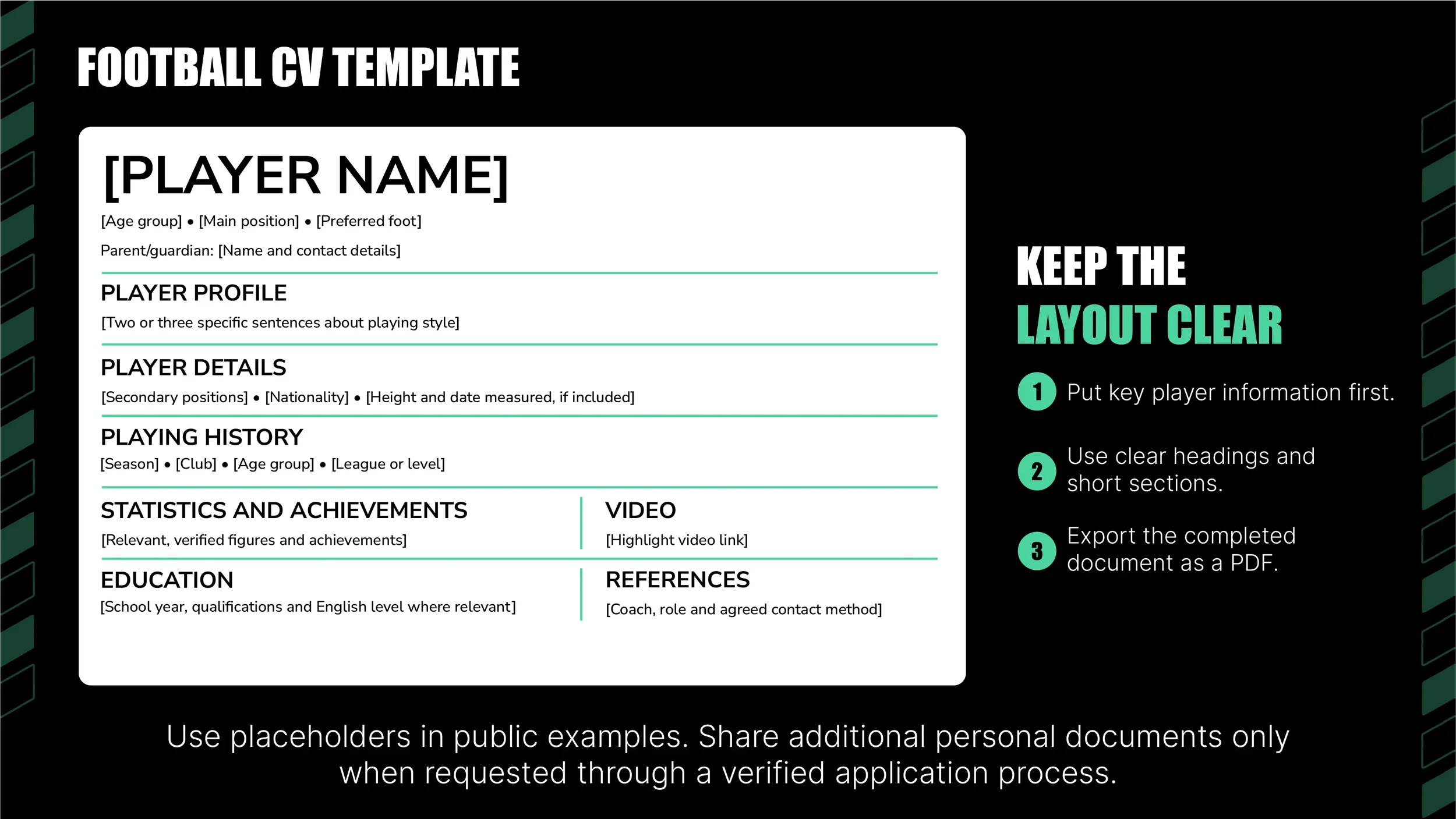
Copy the table below into a document, delete optional fields that do not apply, and adapt it to the instructions of the programme. It is a copyable template in this article, not a separate download.
| Section | What to write |
| Header | Player name, current age group or birth year; add full DOB or nationality only when requested by a verified programme |
| Contact | Parent or guardian name, email and phone for an under-18 player |
| Player profile | Two or three honest sentences on position, role and football strengths |
| Positions | Main position, any genuinely played secondary position and preferred foot |
| Physical details | Optional current height only if relevant or requested; add measurement date |
| Playing history | Current and recent clubs, age groups, level or league, and seasons |
| Statistics | Only reliable, dated figures with competition context; otherwise omit |
| Achievements | A few verifiable selections, awards or responsibilities |
| Education | School year or qualifications if relevant; share reports through official admissions |
| Video | Optional working, permitted link; follow recipient’s duration and format |
| Reference | Coach role and club; contact available on request with permission |
Football CV Example
Here is part of a completed CV for a fictional player. The football details are illustrative, not a real player’s record.
Example: Sam Taylor, U15 central midfielder
Player profile: A right-footed central midfielder who is comfortable receiving under pressure, switches play quickly and reads the game well out of possession. Captain of his current side, known for his consistency and communication.
Positions: Central midfield (main); defensive midfield (secondary). Right-footed, comfortable on the left.
Playing history: 2025/26 – Northfield Juniors U15, county league premier division, captain. 2023–2025 – Northfield Juniors U13–U14, county league. District schools representative, 2025.
2025/26 statistics: 24 appearances, 4 goals, 9 assists.
References: Northfield Juniors U15 head coach; contact details available on request with the coach’s permission.
The example gives the season, level and role, and the figures are presented as if they could be checked. Real applicants should use only information they can verify.

Your future
starts
here
REGISTER
Tailoring Your Football CV by Age and Application
The amount of detail should follow the player’s experience and the programme’s request, rather than a strict age formula. An under-12 profile can be very short: current team, age group, main position and a few football strengths. A player with no formal statistics or video can still describe their current football accurately. Do not invent achievements to make the template look complete.
For an older youth player, include recent playing history and relevant, reliable achievements. A school or scholarship panel may request academic information separately; a university or overseas programme may want education level and availability. Tailor the CV to that verified opportunity, and use Football Scholarships for the broader funding and selection process.
International applicants can add country of residence, education system, suitable contact time zone and realistic availability if requested. Passport nationality or identity evidence belongs in the provider’s official eligibility process rather than an openly circulated CV. See UK vs Overseas Football Academies for the separate eligibility questions.

Who Should Write It: Parent or Player?
Parents can assemble the profile for a younger child, while older players can increasingly describe their own game. A parent or guardian should oversee contact for a minor. Agree the wording with the player and check the dates, competition level and links together. Honest, specific details are more useful than polished but uncheckable claims.
Common Football CV Mistakes to Avoid
The biggest error is presenting an invented or inflated level. A coach can compare the CV with a trial or footage, so use plain descriptions, seasons and competitions that can be checked. Generic claims such as “passionate about football” add little; describe what the player actually does.
Other common errors include a dead or permission-blocked video link, a file the recipient did not request, stale age-group information, statistics without context and a coach listed without consent. Do not post a child’s detailed CV publicly or include a home address, identity documents or private medical information.
Your Academy Application Checklist
Follow the verified programme’s current instructions. The materials it may ask for include:
A concise football CV or player profile, if requested, in the required format
A recent, permitted video link, if requested; test its viewing permissions
A coach reference, if requested and agreed with that coach
A school report or qualifications, if requested through the official admissions process
Proof of age or identity only if requested through a verified, secure application process
Medical or participation information only through the provider’s confidential process
Parent or guardian contact and consent for an under-18 applicant as required by the programme
School and boarding admissions have further requirements. For those, use UK Boarding Schools: Admissions, Scholarships & Visa Guide rather than adding every document to a football CV.
Where to Send Your Football CV
Send a CV only through a verified programme’s stated email, portal or application form. In a brief accompanying message, identify the player’s age group, current team and the specific opportunity, then say where the CV and any requested video are attached or linked. Do not send passports or medical records in a first email. For a professional club, check its official recruitment guidance instead of assuming an unsolicited CV will be reviewed.
How AF Global Uses Your Football CV
AF Global’s current registration form asks for parent or guardian contact details, the player’s football background, current club, position and playing level. A video link is optional; the form does not currently provide a football CV upload field. This guide can help families organise their information, but a CV is not required to complete that form. If the team later asks for one, send it by the channel they specify.
Final Thoughts
A useful football CV is short, accurate and tailored to the verified programme. Put recent football experience and parent contact first, add video only when available and appropriate, and keep a child’s sensitive information out of a widely shared file. Use the copyable template as a starting point and follow each provider’s instructions. AF Global families can register their interest using the current form.
Frequently Asked Questions
-
A football CV is a concise summary of a player’s age group, positions, recent playing history and level, with contact through a parent or guardian for a minor. It may support an application when a programme requests it, but does not replace a trial or football assessment.
-
Usually one clear page. Lead with the age group, current team, main position and parent contact, then add recent playing history and a video link if it is permitted and requested. Leave optional or sensitive fields out unless the verified programme needs them; follow its required file format.
-
Not always. Some independent academies and school or scholarship programmes ask for a CV or profile; others use a form. Professional club recruitment usually starts through observation or referral. Check the specific programme’s official instructions.
-
Only if the figures are reliable and make sense in context. Add the season, age group and competition level; appearances or minutes can be more useful than goals for some positions. A younger player or one without tracked statistics can leave this section blank.