

Football Scholarships in the UK Eligibility Funding and Applications
The word “scholarship” can mean different things in football. A professional club may use it for a full-time development programme at 16, while a school may offer an award towards fees. Colleges and universities also provide football and education opportunities, but their funding and support vary. Understanding the offer matters more than the label.
This guide explains the main types of football scholarship in the UK, who can apply, what an award may cover and how applications work. It also considers international players and girls’ pathways, so families can compare suitable options and understand the terms before accepting a place.

What Is a Football Scholarship in the UK?
A football scholarship in the UK is a place or award that supports a talented player's football development alongside their education. Depending on who offers it, it may provide full-time coaching, a reduction in school or university fees, or practical support such as training, fixtures and flexible study.
Professional clubs, community foundations, colleges, independent schools, universities and private academies use the term in different ways. Their eligibility, funding and selection methods vary, and a programme advertised as a scholarship may not include financial support. American college soccer scholarships use a separate system and are outside the scope of this guide.
The Main Types of Football Scholarship in the UK
| Type | Age | Offered by | What it usually provides | How players are selected |
| Club academy scholarship | 16–18 | Professional club academies | Full-time football programme with education and a training allowance | Mainly from players already in the club's academy |
| Foundation and college programme | 16–19 | Club foundations, FE colleges | A study programme combined with football training and fixtures | Application and trial |
| Independent school scholarship | 11–18 | Independent day and boarding schools | A reduction in fees, plus football within the school programme | Assessment day, interview and academic entry requirements |
| University sports scholarship | 18+ | Universities | Financial support and performance services alongside a degree | Application based on playing level and academic offer |
| Private or foundation award | Varies | Academies, charities and foundations | Varies by award | Each award sets its own criteria |
What Is a Football Academy Scholarship
At a professional club, a football academy scholarship is usually a two-year, full-time programme beginning at 16. It combines training and matches with continued education and a training allowance. Places are selective and often go to players already within the club’s academy. A scholarship can be a step towards a professional contract, but it does not guarantee one. Our guide to Football Scholarships for 16 Year Olds explains this route and the alternatives at that age.
Club foundation and college football programmes
Club foundations and further education colleges often advertise football and education programmes as scholarships. Students work towards a qualification, commonly a BTEC or similar course, alongside training and college fixtures. These can provide a structured environment, but they are separate from a professional club’s academy scholarship and do not usually include a professional playing contract or training allowance. Check both the education offer and any financial support.
Independent school sports and football scholarships
Many independent schools offer sports scholarships to pupils with outstanding sporting potential, and some offer football-specific awards. A scholarship usually reduces fees rather than covering them, and families who need more financial help may also be able to apply for a means-tested bursary. Scholars are expected to play a full part in school sports. Our UK Boarding Schools guide explains how school admissions, scholarships and bursaries work.
University sports scholarships
Many UK universities offer sports scholarships to students who play at a high level. These typically combine a financial award with performance support, such as coaching, strength and conditioning, physiotherapy and flexible study arrangements around training and fixtures. Applicants still need to meet the university's academic entry requirements. For players aged 18 and over, AF Global's Elite Performance Football Pathway at the University of Hertfordshire is one example of elite training combined with a degree.
Private and foundation awards
Some academies, charities and foundations offer their own named scholarships, each with its own purpose, criteria and value. AF Global's named scholarships are one example, and you can read about one of them in Introducing the Lucy Bronze Scholarship. Because these awards vary so much, read each one's terms carefully.
Who Is Eligible for a Football Scholarship?
Age
Eligibility depends on the type of scholarship. Club academy scholarships and most college programmes begin at 16. Independent schools offer sports scholarships at their main entry points, most commonly at 11, 13 and 16, while university scholarships are for students starting a degree, usually from 18.
Football ability and potential
Selectors are looking for potential as much as current level. Technical quality, game understanding, attitude, coachability and resilience all count, and coaches take a player's age and stage of physical development into account. A player doesn't need to be at a professional academy to earn a school or university scholarship, but they do need to be playing regularly at a good standard. Our guide to What Do Scouts Look For in U17 Players explains how older players are assessed.
Academic requirements
Education-based awards also have academic requirements. Schools may use entrance assessments, colleges set course entry grades, and universities require applicants to meet the conditions of their academic offer. The timing of a sports award varies by provider, so check the academic and sporting processes together.
International players
For international players under 18, eligibility to join a professional club is restricted by FIFA’s guidance on international transfers of minors. Limited exceptions exist and may require approval. A school or college offer does not itself establish eligibility to register with a professional club, so families should confirm the player’s position before planning a move.
Education-based awards follow a different admissions process. International students may apply where the school, college or university accepts them, subject to its award criteria and immigration requirements. Eligible pupils aged 4–17 may use the Child Student visa route for independent school study; other students may need the Student route or another appropriate immigration status. Confirm the route with the education provider. Our guide to UK vs Overseas Football Academies provides further context.
Girls' football scholarships
Girls can explore professional game academies at women’s clubs as well as school, college and university routes. Training and education arrangements vary, so check the age range and entry requirements directly. Ask about the girls’ teams, fixture programme and coaching provision, and prepare the evidence requested by each provider.

What Does a Football Scholarship Cover?
Scholarships and bursaries
It helps to understand the difference between a scholarship and a bursary. A scholarship is awarded on merit, recognising a player's talent and potential. A bursary is means-tested, meaning it is based on a family's financial circumstances. At many independent schools, a scholarship on its own covers only part of the fees, and families who need more help apply for a bursary as well. Some schools combine the two.

What is usually covered, and what isn't
| Type | Often covered | Not always covered |
| Club academy scholarship | Coaching, matches, education programme, training allowance | Accommodation, unless the club arranges it |
| Foundation and college programme | Course, coaching and fixtures | Kit, travel and tours |
| Independent school scholarship | A reduction in fees | The remaining fees, boarding extras, trips and travel |
| University sports scholarship | A financial award and performance support | Tuition fees and living costs |
| Private or foundation award | Defined by each award | Anything outside the award's stated terms |
For international families, visa applications, flights, insurance and guardianship arrangements are usually separate costs that a scholarship won't cover. Whatever type you are considering, ask for a written breakdown of exactly what is included and for how long.

Your future
starts
here
REGISTER
How to Apply for a Football Scholarship
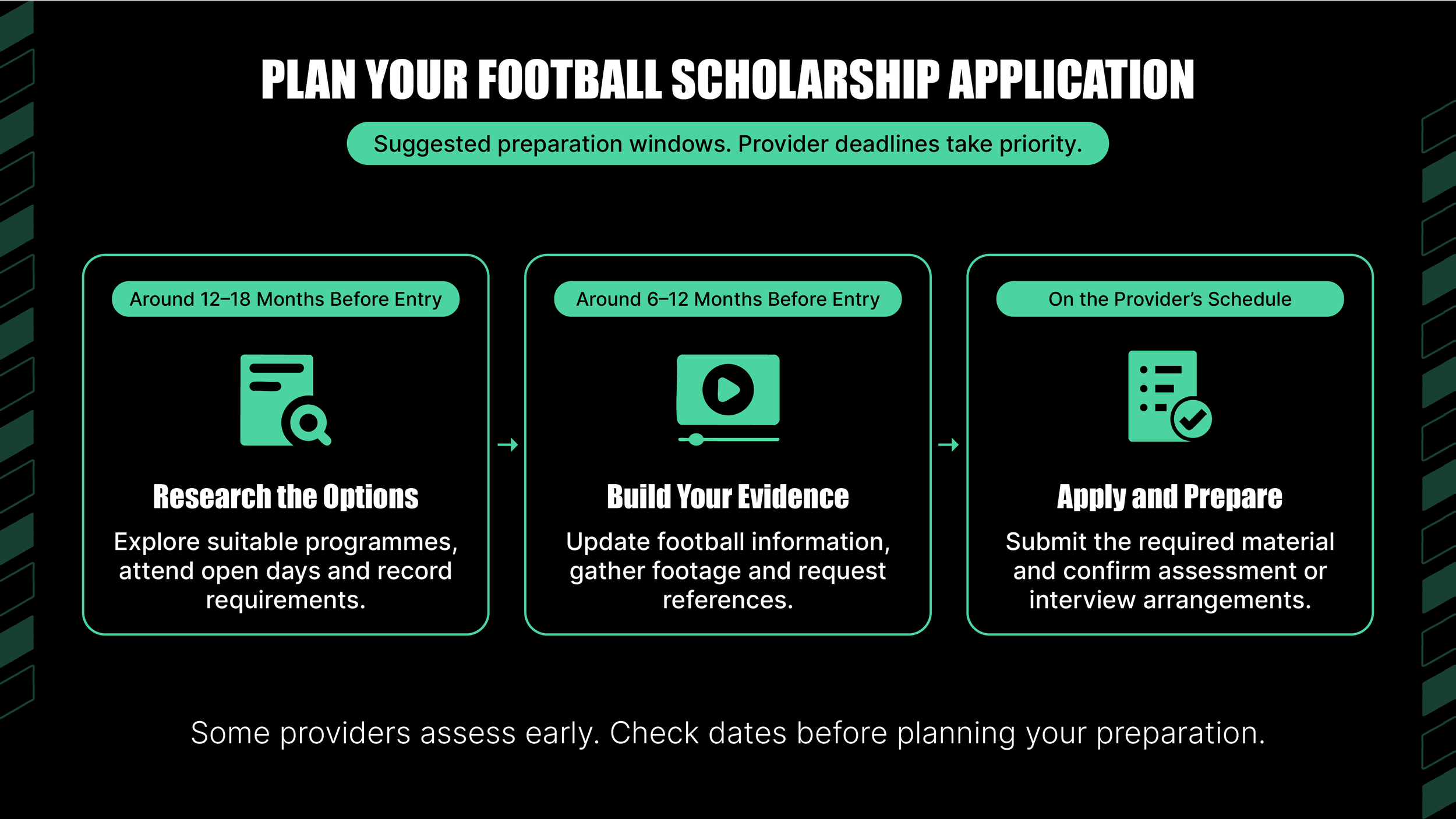
Every provider runs its own process, but most applications follow the same broad stages.
The first stage is research. Match the type of scholarship to your child's age, level and education goals, and shortlist programmes that genuinely fit. A player who wants a professional career, a player who wants elite football alongside top-level academics, and an international student will often need different routes.
Prepare the evidence requested by each provider. This may include a football CV, match footage or a highlight video, coach references and a recent school report. Our guide on How to Write a Football CV for Academy Applications explains how to prepare the CV and video.
Then submit your applications, following each provider's instructions and timings carefully. Many independent schools assess candidates well before the year of entry, and university scholarships usually follow the main admissions cycle, so check each provider's dates early rather than relying on general timelines.
Shortlisted players are usually invited to an assessment day, which may include training drills, match play, fitness testing and an interview. Our guide on How to Get a Football Scholarship explains how to prepare for assessment days and the interview questions players are likely to face.
Finally, there's the offer. A genuine offer comes in writing and sets out the terms. Read it carefully before you agree to anything.
Keeping a Football Scholarship: Conditions and Reviews
A scholarship is rarely a one-off award with no strings attached. Most come with conditions, such as maintaining academic progress, good behaviour and attendance, and a full commitment to the programme's football. Many are reviewed each year, and some can be reduced or withdrawn if the conditions aren't met.
It's worth asking what happens if your child's form dips or they suffer a long-term injury, as policies vary widely. Some providers continue support during recovery, while others review the award. Get the conditions in writing at the start, so there are no surprises later.
Questions to Ask Before Accepting a Scholarship
Before accepting, check what the award covers, how long it lasts and whether it is renewed automatically or reviewed. Ask how training, fixtures and academic commitments fit into the week, and what happens if the player is injured.
If your child will live away from home, confirm who is responsible for welfare and safeguarding. Also ask what happens at the end of the programme and what support is available for the next step, whether that involves another club, university or a different route.
For offers from professional clubs, the PFA's Youth Advisory service offers free, confidential advice to families. The Premier League Parent Hub also explains how the academy system works.
How to Spot Football Scholarship Scams
Be cautious of guaranteed professional contracts, claims of special access to a club or pressure to pay before an offer disappears. Verify a trial invitation directly with the named club. A paid independent training or assessment service is different from a club invitation and should clearly explain what it provides, without promising selection.
Before paying, confirm the organisation’s identity, its relationship with any named club or school, the coaching qualifications and the safeguarding contact. Read the terms and cancellation policy, and ask for written confirmation of anything promised.
Scholarship Opportunities With AF Global
AF Global offers several routes for talented young players. Our free Scholarship Trial Days give boys aged 7 to 11 across London and Kent the chance to experience the programme and be assessed for a scholarship place. For older players, AF Global also offers scholarship opportunities for those aged 16 to 18, combining elite football with education at our partner schools.
Our team looks at each player's football, education and goals, and can help you understand which route fits best. To find out more, register your interest.
Final Thoughts
Start by identifying the type of award that fits your child’s age, playing level and education goals. Compare the football provision with the funding and study requirements, prepare the requested evidence, and read the terms before accepting. To explore opportunities through AF Global, register your interest and our team will discuss the next steps.
Frequently Asked Questions
-
A football scholarship is a place or award that supports a talented player's football development alongside their education. Depending on the provider, it may be a full-time club programme from 16, a college football course, a reduction in school fees or a university sports award.
-
Identify the type of scholarship that suits the player's age and goals, then prepare a football CV, a highlight video, references and school reports. Apply to each provider, attend any assessment day and interview, and check the written terms of any offer before accepting.
-
Yes, through schools, colleges and universities, studying on a Student visa. FIFA's rules on international transfers mean most overseas players can't join a professional club's academy scholarship programme before they turn 18.
-
Rarely. A club academy scholarship includes coaching, education and a training allowance, but school and university scholarships usually cover only part of the cost. Families who need more financial help can often apply for a means-tested bursary.
-
It depends on the type. Independent schools offer sports scholarships at their main entry points, often 11, 13 and 16. Club academy scholarships and college programmes usually start at 16, and university scholarships from 18.
-
Yes. The FA's girls' talent pathway includes professional game academies that combine football with education from 16. Many independent schools and universities also offer sports scholarships to talented female footballers.