

At 16, young footballers and their families need to decide how football will fit around the next stage of education. GCSEs are ending, professional clubs are making scholarship decisions, and students are choosing what to study next.
A professional club scholarship is a selective route, but it is one of several options. Club foundations, colleges, Sixth Form football academies and private programmes also offer ways to train seriously while continuing education. This guide explains what each route involves and how to compare them. For an overview of school, club and university awards, see our guide to Football Scholarships in the UK.

Why 16 Is a Key Decision Point
In England, young people must continue in education or training until 18. At the same time, professional clubs decide which academy players to offer scholarships to, while students choose between A-levels, vocational courses such as BTECs and other post-16 options. These choices affect both their football routine and their next steps in education.
That's why the decision deserves time. The right route depends not only on how good a player is now, but on their education goals and what they want to be able to do at 18, whether or not football becomes their career.
Your Football Options at 16 at a Glance
| Route | Best suited to | Education | How players get in |
| Club academy scholarship | Players already in a professional academy | Delivered by or with the club, alongside full-time training | Selection by the club, usually from its own academy |
| Club foundation or college programme | Players who want daily football with a vocational course | Usually a BTEC or similar sports qualification | Application and trial |
| Sixth Form football academy | Players who want A-levels alongside structured football | A-levels or equivalent at a school or sixth form | Application, assessment and academic entry requirements |
| Private full-time programme | Players wanting an intensive programme outside clubs and schools | Varies; check how it is delivered | Application and assessment; usually fee-paying |
| Grassroots or non-league football plus sixth form | Players who want to keep developing while focusing on study | Standard sixth form or college | Through the club and school or college |
Can You Join a Football Academy at 16
How and when clubs offer scholarships
Yes, but entry depends on the type of academy and its selection requirements. Professional clubs usually make scholarship decisions during a player’s U16 season, often drawing on years of development within their own academy. Players from outside may also be considered after a trial, so families should check each club’s process while exploring other football and education routes. Our guide to Pro Football Academy vs Local Football Academy explains the differences.
What the scholar programme involves
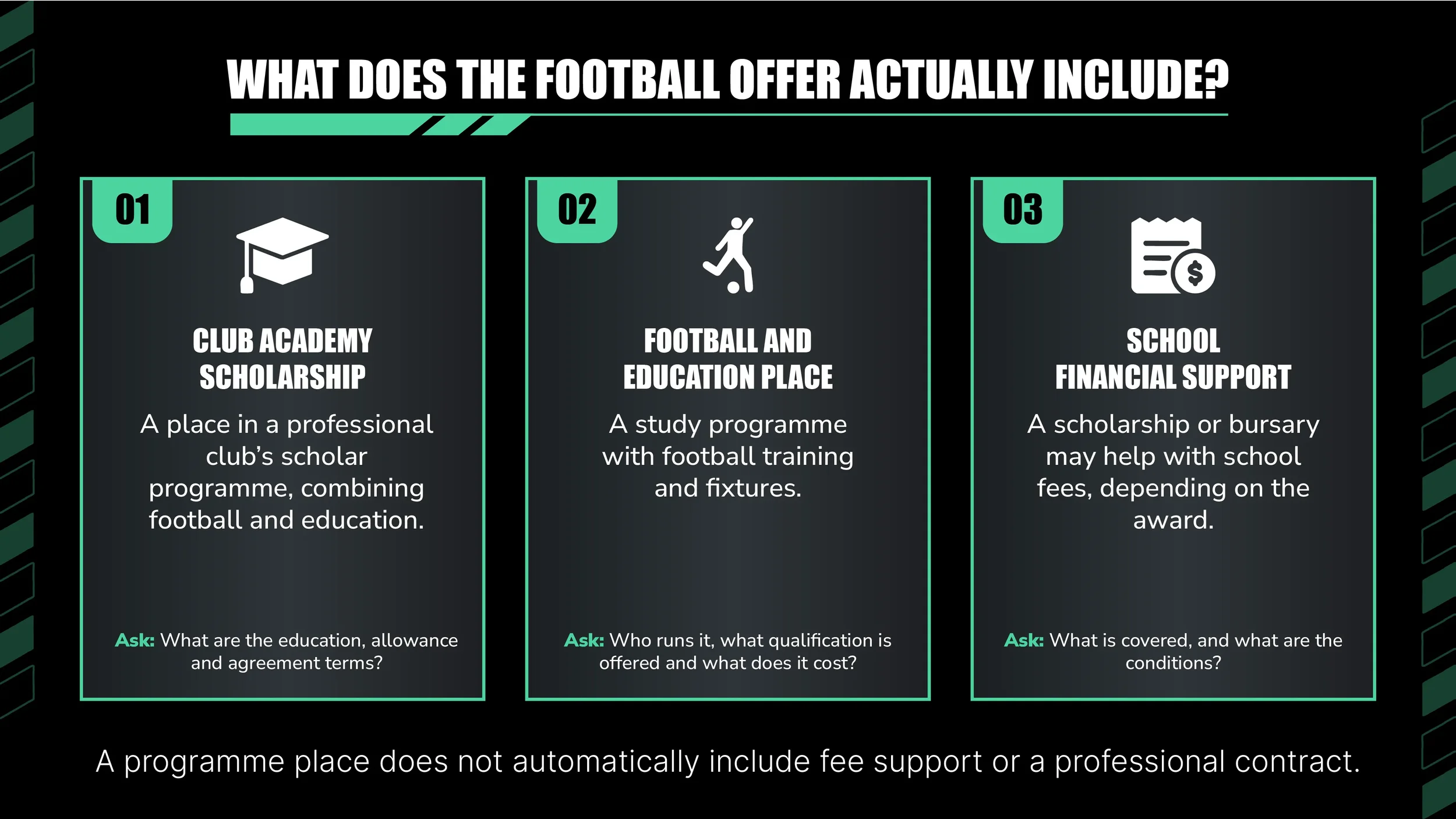
A club scholarship is a two-year, full-time programme, and it is a big step up from schoolboy football. Scholars train most days and play in their club's youth league fixtures, with strength and conditioning, analysis and recovery built into the week. Education continues alongside the football, delivered by or with the club. At many clubs it is structured as a sporting excellence apprenticeship combined with a further qualification. Scholars also receive a training allowance.
The week may combine training, education, gym work, fixtures and recovery. Families should ask how these demands fit together and how academic progress is supported alongside football.
What happens at 18
A scholarship does not guarantee a professional contract. At its end, some players continue with the club while others move to another team or pursue education and work alongside football. Ask what support is available for players who leave, including education and career guidance and opportunities to be seen by other clubs. The PFA offers independent advice to young players and their families.
Club Foundation and College Football Programmes
Many of the football programmes advertised to 16-year-olds are run by professional clubs' community foundations or by further education colleges. They are often described as "football and education programmes" or "post-16 football academies". Students usually study for a BTEC or similar sports qualification while training several times a week and playing in college or programme leagues.
A familiar club badge can make these programmes attractive, but it does not make them equivalent to a club academy scholarship. They do not usually include a professional playing contract or a scholar’s training allowance. Compare the coaching qualifications, training hours, fixture programme and academic qualification, then ask where recent students have progressed.
Sixth Form Football Academies
Some schools and sixth form colleges, both state and independent, run football academies that combine A-levels or equivalent qualifications with a structured football programme. Students take a full academic timetable while training several times a week and playing in school and college competitions.
This route suits players who want to keep a strong academic path open, including to competitive universities, without giving up serious football. Independent schools may offer sports scholarships or means-tested bursaries for Sixth Form entry, and our UK Boarding Schools guide explains how those work. For students who would board, our guide to Residentail football Academies in England explains what boarding life involves.
Private Full-Time Football and Education Programmes
Some private academies run full-time programmes for players aged 16 and over, combining daily training with an education element. They can offer intensive coaching and plenty of games for players who want more than their club or college provides.
These programmes are usually fee-paying, and their education arrangements vary. Before committing, check who delivers the course, whether the qualification is recognised and who is responsible for safeguarding. Review the coaching and fixtures too, and request written terms showing exactly what the fees include.

Your future
starts
here
REGISTER
Football Routes for Girls at 16
Professional game academies at women’s clubs offer a development route for talented young players alongside education. Their arrangements differ from boys’ club scholarships, so families should check the age range, training timetable, education provision and entry process with the individual club.
Beyond the professional game academies, an increasing number of club foundations and colleges now run girls' football and education programmes, and many Sixth Form football academies welcome girls, either in girls' teams or mixed training. When comparing options, ask about the girls' fixture programme, coaching staff and how many girls are currently enrolled, so you know your daughter will be properly challenged.
International Players at 16
For international families, joining an English professional club at 16 involves more than finding a place. FIFA’s guidance on international transfers of minors explains the restrictions and limited exceptions affecting under-18 players. Admission to a school football programme does not itself establish eligibility to register with a professional club.
An independent school may be an education option for an international student, subject to admission and immigration requirements. Eligible 16- and 17-year-olds may use the Child Student visa route; the appropriate route depends on the course and sponsor. Confirm arrangements with the school before applying. Our guide to UK vs Overseas Football Academies provides further context.
How to Choose the Right Route at 16
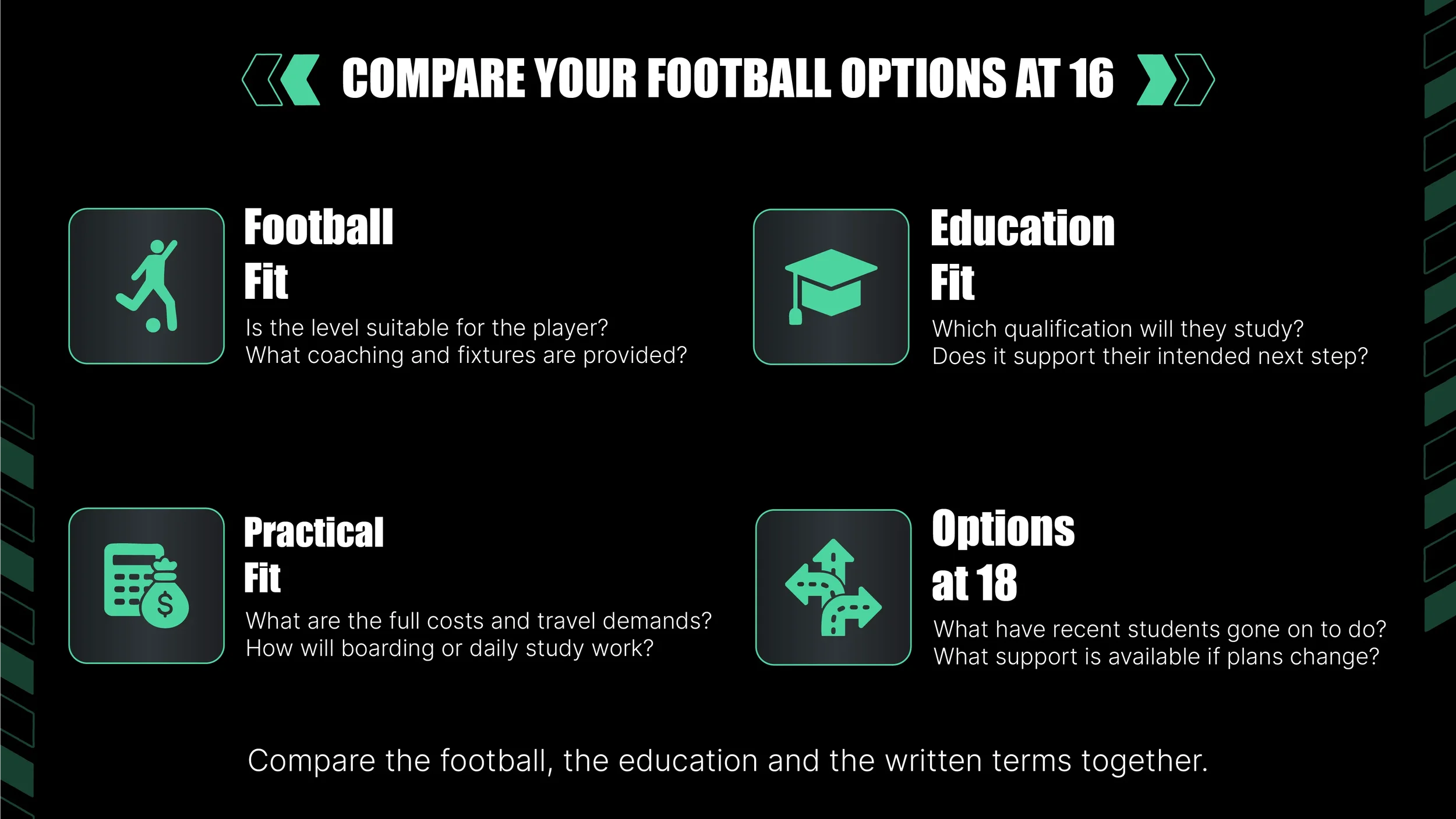
Start with an honest view of your child's current level. A player who has been in a professional academy for several years is in a very different position from one who is the best player in a grassroots team, and their current coach can help you judge which routes are realistic.
Consider the qualifications alongside the football. A-levels and vocational courses such as BTECs can both lead to university, but acceptance depends on the course, subjects and grades. If your child has a particular degree in mind, check its entry requirements before choosing a programme.
Compare the training hours, coaching and fixtures together. Regular games against appropriate opposition give players opportunities to apply what they learn, but the programme also needs to fit around study and recovery. Include travel or boarding when judging the weekly commitment.
Finally, ask what each route leads to at 18. Football careers are uncertain even for the most talented players, so the best route at 16 is one that develops your child as a footballer while keeping strong options open if the game doesn't become their career.
When to Start Looking
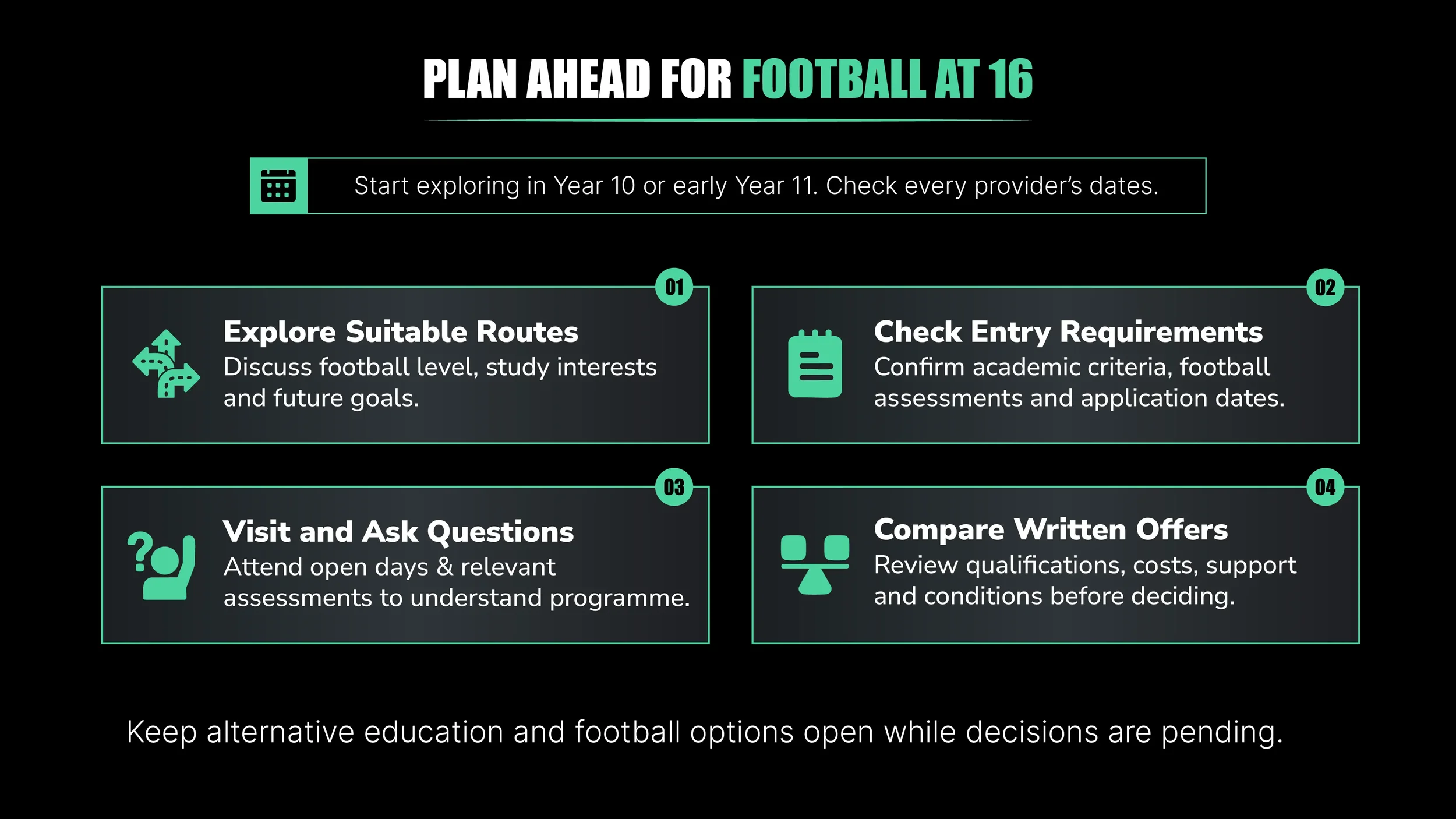
Start exploring options in Year 10 or early in Year 11, while there is still time to attend open days, trials and assessment days. Each provider sets its own timetable, so check dates directly rather than relying on general timelines. Our guide on How to Get a Football Scholarship explains how to put together a strong application and prepare for assessments and interviews.
How AF Global Supports Players at 16
AF Global offers scholarship opportunities for players aged 16 to 18, combining elite football with education at our partner schools. For players aged 14 and over who want structured support as they approach this decision, Elite Player Mentoring offers one-to-one development guidance. And for players looking ahead to 18, our Elite Performance Football Pathway at the University of Hertfordshire combines elite training with a degree.
To talk through your child's options at 16, register your interest and our team will be in touch.
Final Thoughts
The right route at 16 depends on your child’s current level, education goals and family circumstances. Compare the coaching and qualifications, ask what happens at 18, and choose a programme that supports development while keeping future options open. To discuss the routes available through AF Global, register your interest with our team.
Frequently Asked Questions
-
Club academy scholarships rarely go to players from outside the club's system. However, college football programmes, Sixth Form football academies and some independent schools offer places and scholarships to players from grassroots clubs who play at a good standard.
-
Players on a professional club scholarship receive a training allowance. College football programmes, Sixth Form academies and school scholarships don't usually involve any payment to the player.
-
A club scholarship is a full-time professional development programme for players selected by a professional club, usually from its own academy. A college football programme combines a course, often a BTEC, with regular training and fixtures, and doesn't involve a professional registration.
-
Yes. Sixth Form football academies and many independent school scholarships combine football with A-levels. Club scholarship programmes vary in the qualifications they offer, so ask each club what is available.
-
Released players can access education and career support, and some are seen by other clubs. Many continue playing at a good level, or move into university football, which is why the education side of a scholarship matters.
-
Yes. A growing number of colleges, club foundations and Sixth Form football academies run football and education programmes for girls, and the most advanced players may join a Professional Game Academy at a women's professional club.