

THE GIRLS' FOOTBALL PATHWAY IN ENGLAND: EMERGING TALENT CENTRES, ACADEMIES AND SCHOLARSHIPS
Girls' football in England has changed dramatically in recent years. More girls are playing than ever before, the women's game is more visible, and the FA has rebuilt its talent pathway so that promising young players have clearer routes to develop. For parents, though, the new system can be confusing. What is an Emerging Talent Centre? How is it different from an academy? And where do schools, colleges and scholarships fit in?
This guide explains how the girls' football pathway in England works, from grassroots football to Emerging Talent Centres and Professional Game Academies, how trials and selection work, and the education-based routes that combine football with study. Every player's journey is different, and no route is guaranteed, but understanding the system makes it far easier to help your daughter take the right next step.

How the Girls' Football Pathway Works
The FA revamped its women's and girls' talent pathway in 2022 and 2023. At its heart are two programmes: Emerging Talent Centres for younger players and Professional Game Academies at women's professional clubs. Around them sit grassroots clubs, school football and education-based programmes, which remain essential at every stage.
| Stage | Typical age | What it is | How girls join |
| Grassroots and school football | All ages | Club, school and representative football, including mixed teams | Join a local club or school team |
| Emerging Talent Centres (ETCs) | Around 8 to 16 | FA-funded talent programmes run alongside grassroots football | Open recruitment and assessment by each centre |
| Professional Game Academies (PGAs) | Around 14 to 20 | Academies at Women's Super League and Women's Championship clubs | Selection by the club, often from ETCs and grassroots |
| Education-based programmes | 11 to 18 and beyond | School, college and university football, sometimes with scholarships | Application and assessment |
Ages and structures can change, so always check the latest information with the FA and individual centres.
What Is an Emerging Talent Centre?
An Emerging Talent Centre, or ETC, is a talent development programme for girls with footballing potential. ETCs replaced the FA's previous Regional Talent Centres and Advanced Coaching Centres, and there are now around 70 across England. The FA's aim is for most girls to have a centre within reasonable travelling distance of home.
Who runs ETCs and where they are
ETCs are run by professional clubs, National League clubs, County FAs and universities, all working to criteria set by the FA. Many are delivered through a club's community foundation, which is why you will often see them advertised on club websites. The England Football website lists regional contacts so families can find their nearest centre.
What girls do at an ETC
ETCs provide high-quality, age-appropriate coaching rather than a full fixture programme. According to the FA, each centre must run at least one 90-minute training session a week, and players should get a game at least every six weeks, which may include festivals. Sessions include time with qualified coaches, age-appropriate strength and conditioning, specialist goalkeeper coaching and varied formats such as futsal and small-sided games.
Crucially, an ETC is designed to sit alongside a girl's grassroots club, school and representative football, not replace it. Players continue to play their weekly matches with their own teams.
Are Emerging Talent Centres free?
Yes. The FA states that ETCs are free to attend, with the Premier League committing funding to cover the cost. Families still need to cover travel to and from sessions. If any organisation charges a fee for a programme described as an FA Emerging Talent Centre, check directly with the FA or your County FA.
How to Join an Emerging Talent Centre
How ETC trials and selection work
Each ETC runs its own recruitment within the FA's criteria, which require an open and ongoing approach with clear selection criteria. In practice, many centres hold assessment or trial sessions at certain points in the year, while others identify players through recommendations from grassroots coaches, county football and school teachers. Because recruitment is ongoing, girls can join at different ages rather than only at a single entry point.
Dates and processes vary between centres and change each season, so the best approach is to contact your local ETC directly or check its club or County FA page. Searching for last season's trial dates often leads to out-of-date information.
What coaches look for
ETC coaches are looking for potential rather than the finished article. Technique, decision-making, attitude, coachability and enjoyment of the game all matter, and coaches take into account that girls develop at different rates. A player who is still growing into her body, or who started playing later, can still have real potential.
Preparing for an ETC trial
The best preparation is regular football at the right level. Encourage your daughter to play often, enjoy the game and arrive at the session rested and ready to listen to coaches. For practical advice on the day itself, see our guide to Football Trials in England, and for safe, age-appropriate fitness work, see Football Fitness Training for Young Players Preparing for Academy Trials.
Professional Game Academies
Professional Game Academies, or PGAs, are the next step for the most promising players. They are based at clubs in the Women's Super League and Women's Championship, and they replaced the previous FA WSL academies when the revamped pathway launched. PGAs work with players from around 14 to 20, aiming to prepare them for first-team and international football.
Clubs are licensed at different categories, which affects how many age groups they run. Players typically move into a PGA through the club's own identification, often from ETCs, grassroots football or county programmes. If your daughter is offered a place, ask how training fits around school, what education support is available and how her progress will be reviewed. For an independent view, the FA's player pathway team can be contacted through the England Football website.
Keep Playing: Grassroots, School and Representative Football
However talented a young player is, regular football with her own club remains the foundation of her development. Grassroots football gives girls weekly matches, friendships and a love of the game, while school and county representative football add extra challenge. Many girls also play in mixed teams, which the FA allows in youth football and which can provide a high level of competition.

For many players, the most important thing is simply to keep playing regularly and enjoying it. The pathway is designed so that girls can be identified at different ages and from different routes, including from grassroots football.

Your future
starts
here
REGISTER
Education and Football: Schools, Colleges and Scholarships
Alongside the FA pathway, a growing number of education-based programmes help girls combine serious football with their studies. Many independent schools offer sports scholarships to talented female footballers, and some run dedicated girls' football programmes. At 16, colleges, club foundations and Sixth Form football academies increasingly offer girls' football and education programmes, often combining a qualification with daily or near-daily training.
University women's football is also increasingly competitive, and many universities offer sports scholarships with coaching and performance support alongside a degree. Our guide to Football Scholarships in the UK explains how the different types of scholarship work, and Football Scholarships for 16 Year Olds covers the options at 16 in more detail.
If Your Daughter Isn't Selected
Not being selected for an ETC or academy is disappointing, but it is rarely the end of the road. Girls develop at very different rates, recruitment is ongoing, and many players are identified later than others. Ask whether any feedback is available, keep your daughter playing regularly at the right level, and look for opportunities to try again. Our guide to What Happens After Football Academy Trials? explains how to support a young player after a trial, whatever the outcome.
Questions to Ask Any Girls' Football Programme
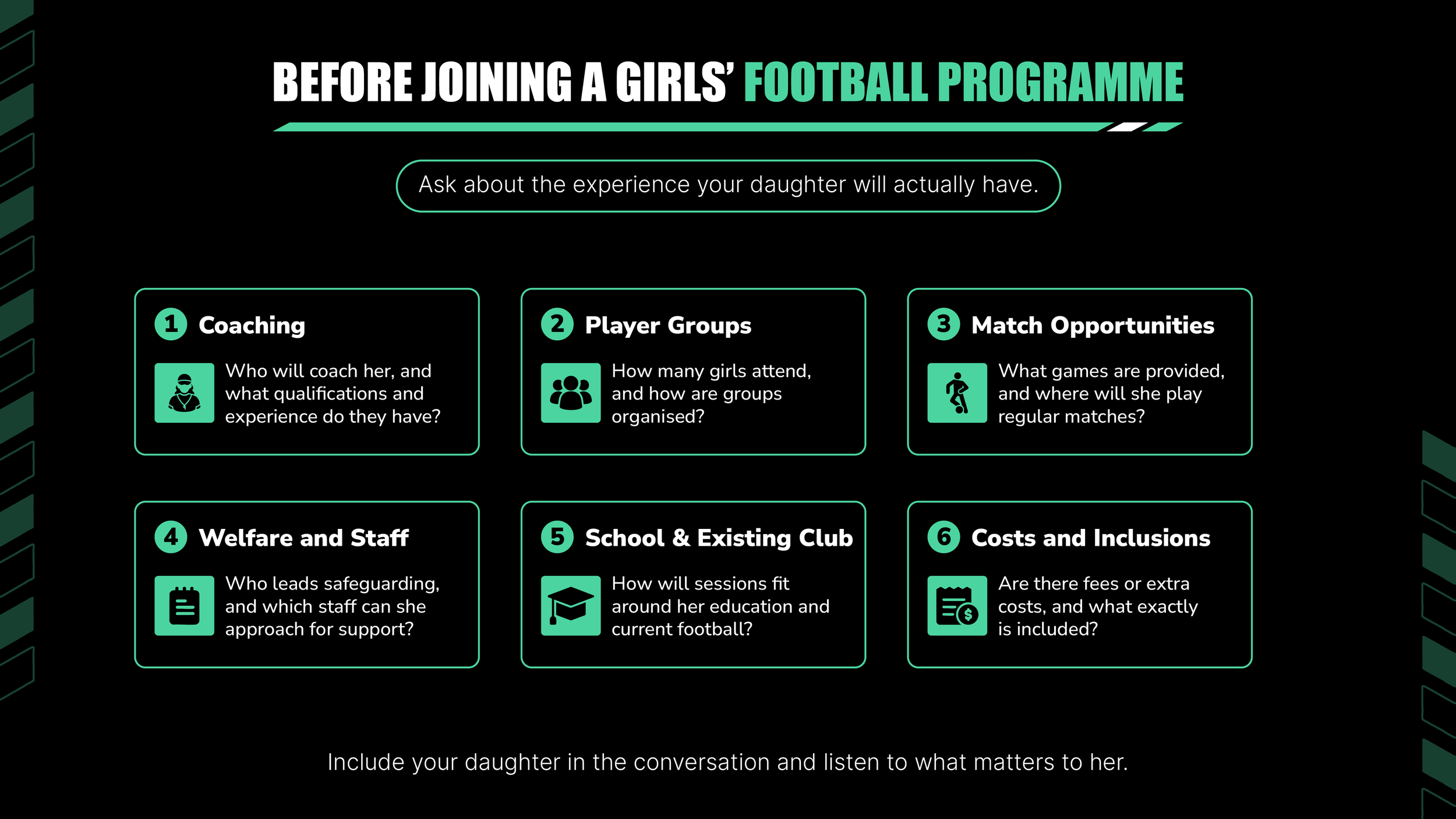
Whether you are considering an ETC, an academy, a school programme or a private academy, a few questions will help you judge whether it is the right fit. Ask what qualifications the coaches hold, how many girls are currently in the programme and how they are grouped by age and ability, and who the teams play. Find out whether there are female coaches or staff, who leads on safeguarding, and how the programme fits around school anad your daughter's existing club. For any programme that charges fees, ask for a clear written breakdown of what is included.
How AF Global Supports Girls in Football
AF Global is committed to helping talented young players combine elite football with a strong education, and that includes supporting girls in the game. The Lucy Bronze Scholarship is one example of AF Global's commitment to developing talented female players.
If you'd like to talk about your daughter's football and education options, register your interest and our team will be in touch.
Final Thoughts
The girls' football pathway in England offers more opportunities than ever before, from free Emerging Talent Centres to Professional Game Academies and education-based programmes. Keep your daughter playing regularly and enjoying the game, find out what your local ETC offers, and remember that there is more than one route to the top. When you're ready to explore the next step, register with AF Global.
Frequently Asked Questions
-
An Emerging Talent Centre (ETC) is an FA-backed talent programme for girls with footballing potential, run by professional clubs, National League clubs, County FAs and universities. ETCs provide high-quality coaching alongside a girl's grassroots club and school football.
-
Each ETC runs its own open and ongoing recruitment, which may include assessment sessions and recommendations from grassroots coaches or schools. Contact your local ETC directly for its current process, because dates and methods vary between centres.
-
ETCs work with girls from around the age of 8 to 16, although each centre chooses which age groups it runs. Check with your local centre which age groups it currently offers.
-
Yes. The FA states that ETCs are free to attend, with funding provided to cover the cost. Families still need to pay for travel to sessions.
-
An ETC is a talent development programme that runs alongside a girl's grassroots football, usually with one main session a week. A Professional Game Academy is based at a Women's Super League or Women's Championship club and offers a more intensive programme for older, more advanced players.
-
Yes. The FA allows mixed football in youth football in England, and many girls play in mixed teams alongside or before joining girls' teams. Both can offer valuable experience.