

FOOTBALL SHOOTING DRILLS FOR YOUNG PLAYERS: POWER, ACCURACY AND FINISHING
Every young footballer wants to score, but chances are often missed because of technique rather than a lack of confidence. A shot that flies over the bar usually comes from leaning back. A shot straight at the goalkeeper often comes from rushing the decision.
This guide brings together football shooting drills for young players, organised from clean ball striking to finishing under match-like pressure. Each drill includes a set-up, how it works, how to progress it and the key coaching points, along with age guidance, common mistakes and ways to measure improvement.
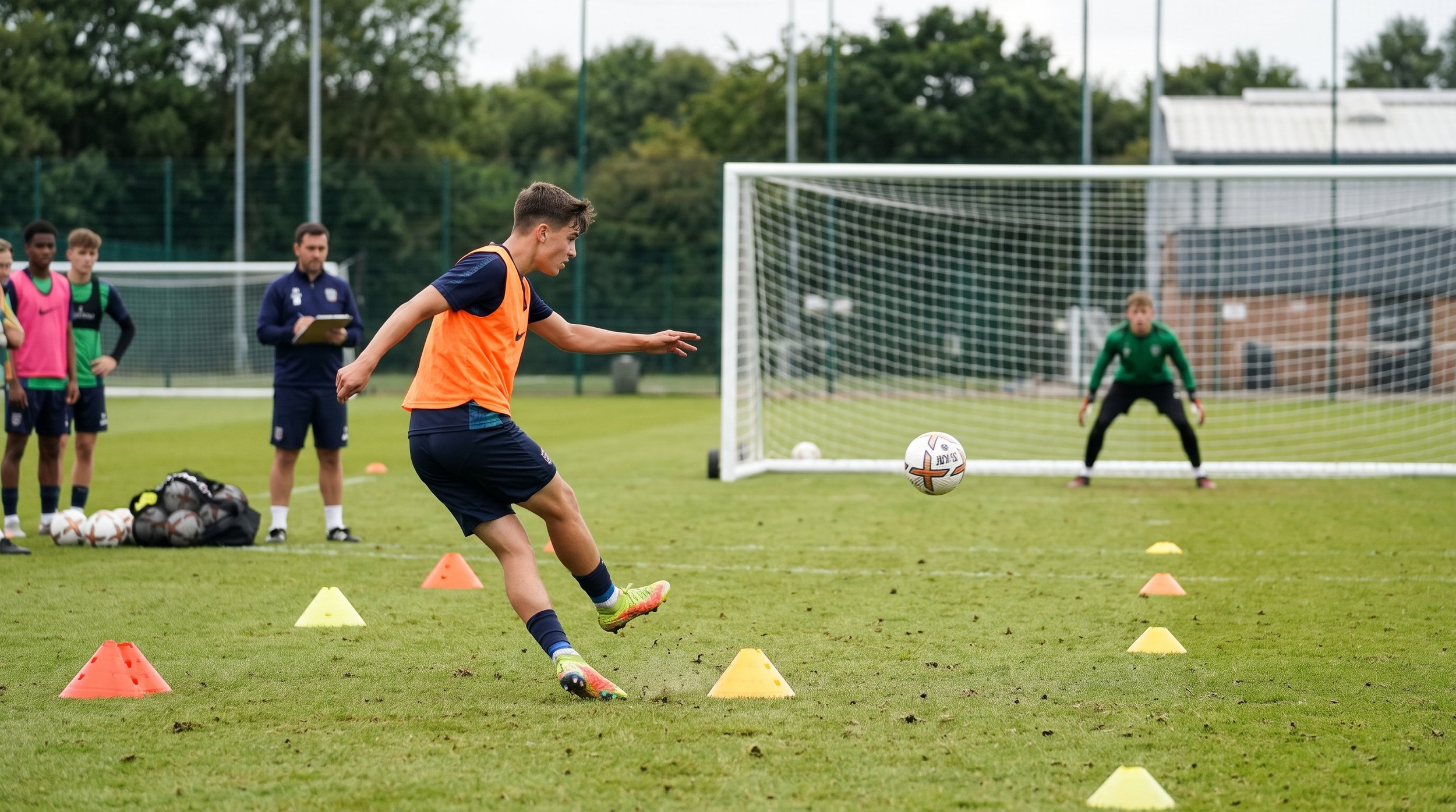
Shooting vs Finishing: What's the Difference?
Shooting is the technique of striking the ball at goal: how a player approaches the ball, where they plant their standing foot and which part of the foot makes contact. Finishing is the skill of choosing and executing the right shot in a real match situation, often with a defender closing in, a goalkeeper set and only a moment to decide. Good finishers need both, which is why the drills below start with technique and gradually add movement, decisions and pressure.
How to Strike the Ball: The Fundamentals
Most good shots share the same building blocks. The player approaches the ball at a slight angle rather than straight on, which allows the hips to swing through naturally. The standing foot is planted beside the ball, roughly in line with it and pointing towards the target. The ankle of the kicking foot is locked, the body is over the ball and the eyes stay on the ball at the moment of contact. After contact, the kicking leg follows through towards the target and the player lands on their kicking foot.
Young players mainly use two contact surfaces. The inside of the foot gives control and placement, so it suits finishing from close range or passing the ball into the corner. The laces, sometimes called the instep, give power, so they suit longer shots and driven finishes. Two problems appear again and again: shots that rise over the bar usually come from leaning back or planting the standing foot too far behind the ball, while shots that slice wide often come from the hips opening too early or striking across the ball.
Accuracy First, Then Power
Young players often try to hit the ball as hard as they can, but placement wins more goals than power at youth level. A well-placed shot into the bottom corner is much harder to save than a powerful shot straight at the goalkeeper. Players should learn to strike cleanly and accurately first, then gradually add power without losing technique.
A useful guide is to shoot at around 70 to 80 per cent of full power, which keeps the body balanced and the ball under control. As a general rule, encourage players to aim low and across the goalkeeper, towards the far post. Low shots are harder to save, and shots across the goal create rebound chances for teammates.
How to Use These Drills: Age and Progression
The most effective shooting practice follows a clear progression. Players first practise technique with no pressure, often against targets rather than a goalkeeper. Next comes finishing from a pass or after movement. Then pressure is added, first from a recovering defender and then from a goalkeeper, before the skill is tested in a small-sided game. A good rule is to progress once players are striking cleanly and hitting the target most of the time.
| Age group | Typical shooting distance | Ball size (FA guidance) | When to add pressure |
| U9 to U11 | 6 to 12 metres | Size 3 | Mostly unopposed and fun target games; add a goalkeeper for short, game-based finishing |
| U12 to U13 | 10 to 18 metres | Size 4 | Recovering defenders, goalkeepers and small-sided games |
| U14 to U18 | 12 to 25 metres or more | Size 5 | Most practices opposed and played at match speed |
Ball sizes follow the FA's updated youth football guidance, which is being phased in, so check what your league currently uses. Adapt distances and pressure to your players' ability.
Goalkeepers deserve care in shooting sessions. Rotate them regularly so no one faces too many shots, avoid powerful shots from very close range at young goalkeepers, and use targets or mini goals for repetitive technique work. Goalkeeper coaching itself is a separate skill, which we cover in our guide to Goalkeeper Training for Young Footballers. A good warm-up matters too, and our guide to Football Fitness Training for Young Players Preparing for Academy Trials explains how to prepare players' bodies before sessions.
Accuracy Drills
Target zone shooting
Set-up: Hang bibs or place cones in the four corners of a goal to create target zones. Players line up 8 to 15 metres from goal, depending on age, with a ball each.
How it works: Players take turns to shoot, scoring points for hitting each zone, with more points for the bottom corners. Run it as a team competition to keep the session lively.
Progression: Increase the distance, shoot from different angles, or require a touch to set the ball before shooting.
Coaching points: Look for the standing foot pointing at the target, the body over the ball and a smooth follow-through. Praise accurate placement, not just goals.
Gate finishing
Set-up: Place two or three small gates, about one metre wide, between the shooting area and the goal.
How it works: Players must pass the ball into the goal through a gate with the inside of the foot, as if finishing past a defender's legs.
Coaching points: This drill rewards calm placement over power. Encourage players to pick their target before they strike and to keep the ball low.
Weaker-foot finishing
Set-up: Two lines of players either side of the goal area, with balls fed from the centre.
How it works: Players finish with whichever foot is furthest from the feeder, so they must use both feet. Award double points for goals with the weaker foot.
Coaching points: Weaker-foot finishing improves fastest with frequent, low-pressure repetitions. Short, regular practice is more effective than occasional long sessions.

Power Drills
Laces strike from a rolling ball
Set-up: A feeder rolls the ball towards a player from about ten metres away. The shooter starts 16 to 20 metres from goal for older players, and closer for younger ones.
How it works: The shooter takes one touch to set the ball, then drives a low shot at goal with the laces.
Progression: Shoot first time from the roll, or from a ball rolled across the shooter rather than towards them.
Coaching points: Power comes from technique, not effort. Look for a locked ankle, contact through the middle of the ball, the knee over the ball and the body moving forward through the shot. If shots are rising, the player is usually leaning back.
Shooting from outside the box
Set-up: A small-sided area with a goal and goalkeeper, and a line marked about 16 metres out.
How it works: Players dribble or receive the ball and must shoot from outside the line. Gradually move the line back as players improve.
Coaching points: Encourage players to look up before shooting, to aim low and to follow up any rebound.
First-Time Finishing Drills
Rolled feed to a first-time finish
Set-up: A coach or player stands to the side of the penalty area with a supply of balls. Shooters start about 15 metres from goal.
How it works: The feeder rolls the ball into the shooter's path, and the shooter finishes first time. Start with slow, simple feeds and progress to firmer passes from a teammate.
Coaching points: First-time finishing depends on preparation. Players should adjust their feet early, keep their body over the ball and use the inside of the foot when accuracy matters more than power.
Finishing from a cut-back
Set-up: A winger starts near the byline with the ball, and a finisher starts on the edge of the penalty area.
How it works: The winger dribbles towards the byline and cuts the ball back across the area, while the finisher times a run to meet it and shoots first time.
Coaching points: Look for a well-timed run that arrives as the ball does, rather than waiting in position. A shot first time is often best when the ball arrives cleanly and the goalkeeper is out of position, but taking a touch can be better when the pass is awkward or there is time to pick a spot.

Your future
starts
here
REGISTER
Receive, Turn and Shoot Drills
Turn and shoot
Set-up: A player stands with their back to goal, about 18 metres out, with a passer in front of them.
How it works: The passer plays the ball in, and the receiver turns and shoots. Start with no pressure, then add a passive defender behind the receiver.
Coaching points: Look for a check over the shoulder before receiving, an open body shape and a first touch that turns the player and sets the ball up to shoot. Our guide to Football Passing Drills for Young Players covers receiving on the half-turn in more detail.
Pass, move and finish
Set-up: A striker, a midfielder and a goal, with a mannequin or cone as a defender.
How it works: The striker plays a one-two with the midfielder around the defender and finishes. Rotate positions after each turn.
Coaching points: The aim is a clean finish after movement. Encourage the striker to keep moving after their first pass and to set their body early to shoot.

Finishing Under Pressure
Finishing with a recovering defender
Set-up: A striker starts about 25 metres from goal with the ball. A defender starts a few metres behind them.
How it works: On the coach's signal, the striker drives towards goal and must shoot before the defender catches up.
Coaching points: This drill teaches players to shoot early and decisively when a defender is closing. Look for players choosing a target quickly rather than taking extra touches.
2v1 to goal
Set-up: Two attackers and one defender start about 30 metres from goal, with a goalkeeper.
How it works: The attackers try to score, choosing whether to shoot or pass to create a better chance.
Coaching points: Help players recognise when to shoot and when a pass gives a teammate a clearer chance. This is where shooting becomes finishing.

Small-sided finishing game
Set-up: A 4v4 or 5v5 game on a small pitch with goalkeepers.
How it works: Play with a condition that rewards shooting, such as a double goal for a first-time finish or a goal from outside a marked line.
Coaching points: Encourage players to shoot when they have a sight of goal, and to follow up for rebounds. We cover beating defenders one-on-one in our guide to Football Dribbling Drills for Young Players.
Coaching Points and Common Shooting Mistakes
Most shooting problems in young players come from a small number of habits. The table below sets out the most common ones and how to fix them.
| Mistake | What it looks like | How to fix it |
| Leaning back | The ball rises over the bar | Practise with the body over the ball and the knee over the ball at contact |
| Standing foot in the wrong place | Shots are weak or go off target | Plant the standing foot beside the ball, pointing at the target |
| Toe-poking | The ball goes in unpredictable directions | Practise striking with the laces and inside of the foot, with the ankle locked |
| Looking at the goal at contact | Mis-hit or scuffed shots | Choose a target before striking, then keep the eyes on the ball |
| Always using the stronger foot | Chances lost while adjusting the ball | Set weaker-foot targets and award extra points for weaker-foot goals |
| Rushing the shot | Snatched shots straight at the goalkeeper | Use target practice and remind players to pick a spot low and across goal |
When giving feedback, keep it short and specific, and focus on one point at a time, such as "keep your body over the ball". Praise good technique and good decisions even when the shot doesn't go in.
How to Measure Shooting Improvement
Counting goals only tells part of the story, because it depends on the goalkeeper as much as the shooter. A more useful picture looks at quality as well as outcome. Coaches and parents can track the percentage of shots on target, hits in target zones, goals with each foot, success with first-time finishes and whether players are choosing sensible shooting positions. Filming a few shooting practices every month is an easy way to spot changes in technique.
How AF Global Develops Finishing
At AF Global, shooting and finishing are part of players' weekly training with UEFA-licensed coaches, alongside technical, tactical and physical development. Sessions progress from clean ball striking to realistic finishing under pressure, so players learn to stay composed in front of goal.
Video analysis through our work with The Edge in Sport helps players review their technique and decisions, and data from Playermaker helps them understand how they use each foot. To find out how your child could develop in an elite football and education environment, register your interest.
Final Thoughts
The best shooting drills for young players build clean technique first, then add accuracy, power, movement and pressure step by step. Encourage placement over power, practise regularly with both feet, and help players learn when to shoot first time and when to take a touch. When you're ready to take the next step, register with AF Global.
Frequently Asked Questions
-
Target zone shooting, gate finishing and simple first-time finishing from a rolled feed are excellent for young players because they build technique without too much pressure. As players improve, turn-and-shoot drills, recovering defenders and small-sided finishing games add realism.
-
Contact with the inside of the foot gives control and placement, while the laces give power. Keeping the body over the ball and the standing foot beside it keeps shots low and accurate. Leaning back usually sends the ball over the bar.
-
Learn to strike accurately first, then add power gradually. Shooting at around 70 to 80 per cent of full power keeps the body balanced and the ball under control, and aiming low and across the goalkeeper makes even a less powerful shot hard to save.
-
Start with slow, simple feeds that roll straight into the player's path, then progress to firmer passes, crosses and cut-backs from different angles. Encourage players to set their feet early and use the inside of the foot when accuracy matters most.
-
Add a timed run onto a pass, then a recovering defender and a goalkeeper, and finish with small-sided games that reward shooting. Players learn to choose a target and shoot quickly, as they must in a match.
-
Adjust shooting distance, target size, ball size and the amount of pressure so players succeed most of the time but are still challenged. Keep feedback short and specific, and praise good technique and decisions as well as goals.