

What Is a Football Academy? Structure, Training and Career Outcomes
Football academies are a major route into professional football in England. Yet for many parents, the word "academy" raises as many questions as it answers. What actually happens there? How much time does it take? And what are the real chances of a professional contract at the end of it?
Here is the honest answer up front. A football academy is a structured development system, not a guarantee of a playing career. The best academies develop the whole person: the player, the student and the young adult.

This guide explains what a football academy is, the main types, how English academies are structured, and what training looks like week to week. It also covers how education and welfare fit in, and where academy football realistically leads.
Key takeaways
A football academy develops young players through planned coaching, games and feedback, with education and welfare support appropriate to the programme.
In England, club academies follow the Elite Player Performance Plan (EPPP) and are graded from Category 1 to Category 4.
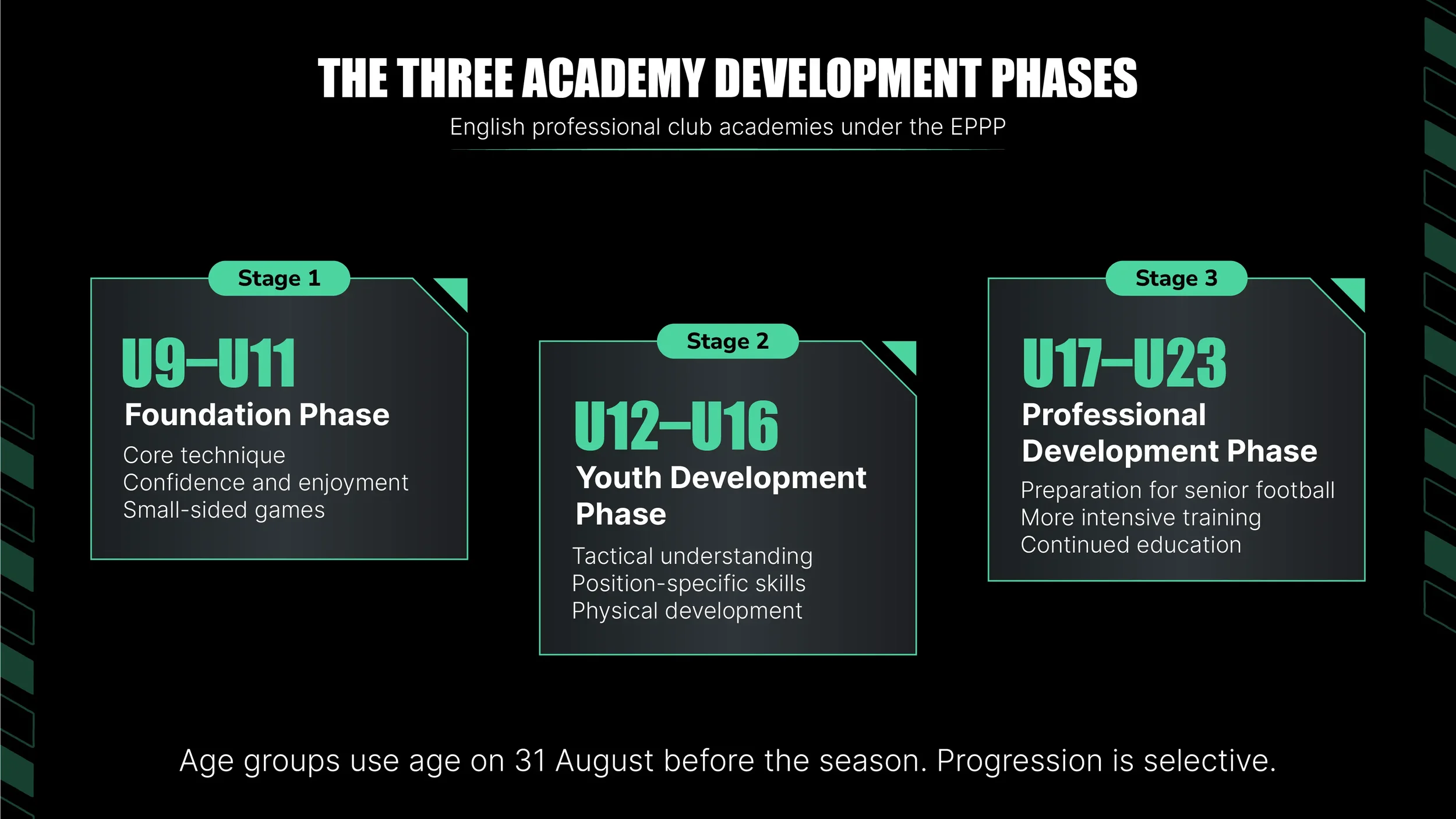
Players progress through three phases: Foundation (U9–U11), Youth Development (U12–U16) and Professional Development (U17–U23).
Only a minority of academy players go on to play league football, which is why education and dual-career planning matter.
Club academies are one route. Private, residential and school-based academies offer others.
What Is a Football Academy?
A football academy is a structured player development programme. At a professional club, players are selected and registered under the English academy system. Independent programmes may also use the name "academy", but they set their own admission criteria. A good programme combines qualified coaching, a planned curriculum, competitive matches and appropriate education and welfare support to help young players reach their potential, on and off the pitch.
In a professional club academy, three features distinguish the structured pathway from a typical youth team:
Selection: players are identified and invited in, usually after being scouted and assessed over time.
A development curriculum: training follows a long-term plan across age groups, rather than simply preparing for next weekend's match.
Specialist support: coaches, sports scientists, medical staff, education officers and welfare staff all work around the player.
Grassroots clubs play a vital role, and many academy players still come from them. The difference lies in structure, intensity and support. We compare the two in detail in Pro Football Academy vs Local Football Academy.
The Main Types of Football Academies
Not every programme called an academy operates in the same way. Here are four routes families may encounter. The EPPP categories and coaching-hour rules discussed later apply specifically to English professional club academies.
Professional club academies
These are run by Premier League and English Football League (EFL) clubs under the EPPP. Registered players do not pay club academy coaching or registration fees. Recruitment is selective, and competition for places is intense. This is the formally audited club pathway most people picture when they hear "academy".
Private football academies
Private academies run independently of professional clubs. Many offer full-time training alongside education, often for international players, late developers or players who have not yet been scouted. They may charge fees and use their own admission criteria. They are not automatically EPPP-licensed or linked to a professional club merely because they use the word "academy". See Pro Football Academy vs Local Football Academy for a fuller comparison.
Residential and school-based academies
Some academies operate inside independent boarding schools or universities. Players live, study and train in one place, so education and football are timetabled together. We explain how this works in Residential Football Academies in England Explained.
Overseas academies
Spain, in particular, has its own academy tradition, known as the cantera (literally "quarry"). It attracts many international families. We compare the options in UK Football Academies vs Overseas Options.

What to check behind the academy name
Ask whether your child would be formally registered with a professional club, or joining an independent training programme or development centre. Check who runs the sessions, how players are assessed, what feedback families receive, and which education and safeguarding arrangements apply. A club badge, an "elite" label or a claimed route to scouts does not by itself establish EPPP academy status.
What does a football academy cost?
Registered EPPP club academy players do not pay coaching or registration fees, although families may still need to budget for travel, personal equipment and time away from work. Development centres and private or residential programmes may charge fees; ask each provider for a written breakdown of tuition, boarding and other costs. Club-to-club training compensation under EPPP is not a bill for the player or parents.
How English Football Academies Are Structured
The Elite Player Performance Plan (EPPP)
The Elite Player Performance Plan is the framework that governs club academies in England. It was introduced in 2012 to raise the number and quality of homegrown players. The EPPP sets rules for coaching hours, staffing, facilities, education, welfare and player registration. Every club academy is audited against it.
Academy categories 1 to 4
Each club academy is awarded a category based on its resources, staffing and standards. The category affects how much coaching players receive, where the academy can recruit from, and which age groups it can run.
| Category | What it means | Age groups |
| Category 1 | The highest standard. The most coaching hours, full-time staff, and the option of a full-time training model. | Foundation to Professional Development |
| Category 2 | High-quality provision with slightly fewer coaching hours and resources than Category 1. | Foundation to Professional Development |
| Category 3 | A more regional focus, with fewer weekly coaching hours. | Foundation to Professional Development |
| Category 4 | Focused on older players and late developers. | Professional Development Phase only |
A higher category doesn't automatically mean a better fit for every child. Playing time, coaching style and how the environment suits your child matter just as much.
The three development phases
Registered English club academy players move through three EPPP phases. An age group is based on the player’s age on 31 August before the season. These phases do not define the age ranges of every private or overseas programme.
Foundation Phase (U9–U11): fun, confidence and core technique. Lots of time on the ball, small-sided games and a love of the game come first.
Youth Development Phase (U12–U16): coaching hours increase. Players develop tactical understanding, position-specific skills and physical capacity as they grow.
Professional Development Phase (U17–U23): the step towards senior football. Most players who stay on at 16 join on a scholarship, combining full-time training with education, and the strongest may earn professional contracts.
Part-time, hybrid and full-time training models
Academies fit training around school in one of three ways:
Part-time: players train in the evenings, at weekends and during holidays, and attend their normal school.
Hybrid: players are released from school for part of the week to train at the academy.
Full-time: available only in Category 1 academies during the Youth Development Phase. The club takes responsibility for delivering both football and education.
The model a player follows depends on their age, their academy's category and what is right for their schooling.

Your future
starts
here
REGISTER
What Training at a Football Academy Looks Like
Coaching hours by category
For registered English club academy players in the Foundation and Youth Development phases, the Premier League publishes these guideline coaching contact hours:
| Category | Foundation Phase (U9–U11) | Youth Development Phase (U12–U16) |
| Category 1 | 4 hours a week, rising to 8 | 8 hours a week, rising to 12 |
| Category 2 | 4 hours a week, rising to 6 | 7 hours a week, rising to 12 |
| Category 3 | 4 hours a week | 5 hours a week, rising to 7 |
Source: Premier League Parent Hub. Coaches adjust these hours to suit each player’s individual programme.
What does a player do each week?
An academy week can include technical and tactical training, matches, individual feedback, age-appropriate physical preparation, video review and recovery. Schoolwork continues alongside football. The exact timetable varies by age, academy category and the player’s individual programme; younger players generally spend less time in organised training than older scholars.
The four areas of development
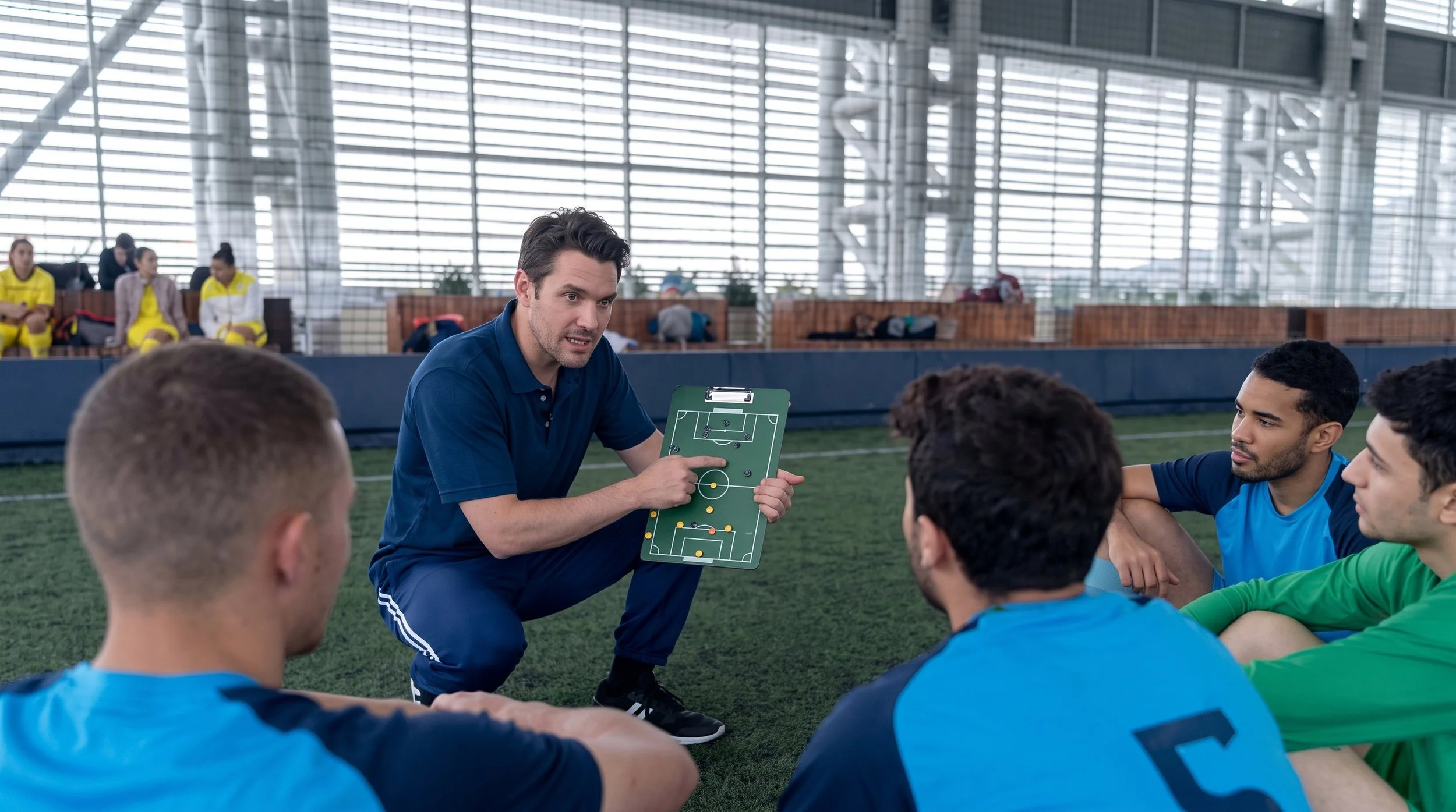
Football development goes beyond ball skills. The FA’s four-corner model encourages coaches to consider four connected aspects of a player’s development:
Technical and tactical: first touch, passing, 1v1s, positioning, decision-making and game understanding.
Physical: speed, agility, strength, endurance and injury prevention, matched to each player's stage of growth.
Psychological: confidence, resilience, focus and handling pressure and feedback.
Social: communication, teamwork, leadership and behaviour on and off the pitch.
The games programme
Matches are part of the curriculum, not just a weekend result. Academy fixtures are designed to give players the right challenge at the right time. They often match players against opponents of a similar standard, sometimes playing up or down an age group. The aim is learning and development, not winning league tables at U10.
Sports science, data and mental performance
Modern academies track development in detail. GPS and wearable technology measure workload and movement. Video analysis helps players review decisions, and individual development plans set clear targets. Mental performance coaching is increasingly standard too.
At AF Global, for example, players benefit from partnerships with Playermaker for performance tracking and Ahead For The Game for mental performance.
Education and Welfare Inside an Academy
Education is part of the pathway
In a well-run academy, education isn't a back-up plan. It is part of becoming an intelligent, adaptable player. Club academies must monitor players' schooling and make sure football doesn't harm their academic progress. Each academy has a Head of Education, and families should receive regular feedback on how their child is doing in the classroom as well as on the pitch.
Player care and safeguarding
Club academies have safeguarding responsibilities, including a dedicated Head of Safeguarding and an Academy Safeguarding Officer. Category 1, 2 and 3 academies also have a Head of Player Care to coordinate players’ personal, social and emotional development. Appropriately qualified first-aid and primary-care staff must be present at games and training sessions. English football also has age-based heading guidance to protect young players.
What parents should expect
When a player joins, the academy should hold an induction. This explains the coaching, games and education programmes and introduces key staff. Players are then reviewed regularly, and their progress across football, education, sports science and medical care is recorded throughout their time at the club.
The dual-career model
Some academies go further by fully integrating football and education. AF Global's coaching staff work on-site within partner independent boarding schools and universities. Training and lessons are built into one balanced timetable, with dedicated pastoral and academic support. The Independent Schools Inspectorate has noted how well players on the programme are supported to balance training with their studies.

Career Outcomes: Where Football Academies Really Lead
The honest numbers
Parents deserve realistic expectations. The Premier League reports that 77% of academy parents have moderate-to-high expectations that their child will become a professional. The data tells a more sobering story.
Among recent academy graduates in the Premier League figures, the share who made at least one league appearance, grouped by the category of their first academy, was:
16% of those whose first academy was Category 1
9% from Category 2
5% from Category 3
The share who made 20 or more league appearances was 11%, 6% and 3% respectively. A league appearance is not the same measure as receiving a professional contract or sustaining a professional career. Source: Premier League Parent Hub.
This isn't a failure of the system. It is the reality of elite sport. Of those players, only some go on to play regularly at the top level. That is exactly why the rest of an academy experience (education, character and life skills) matters so much.
Scholarships at 16 and professional contracts
A key decision point comes at the end of the U16 season, when clubs decide which players to offer scholarships. Scholars combine more intensive training with education, which may include a sports qualification or A-Levels. Some may subsequently receive a professional contract; scholarship duration and terms should be checked with the club rather than assumed to be the same everywhere.
Retain, release and aftercare
At several points, clubs decide whether to retain or release each player. Release can be difficult, but players may continue in other clubs, private programmes, university football or other environments. Clubs must have an aftercare strategy, including a three-year commitment of support for players who depart during the Professional Development Phase. Independent, confidential advice is available through the PFA Youth Advisory Service. PFA Youth Advisory.
Careers beyond playing
An academy education opens doors well beyond a playing contract, including:
University football, in the UK or through US college scholarships
Coaching, starting with FA qualifications and progressing to UEFA licences
Sports science, analysis, physiotherapy and performance roles
Business, media and industry careers within and outside football
This long view shapes how AF Global works. Its Futures Programme prepares every player for life beyond the game through mentorship, employability training and entrepreneurship workshops. AF Global has produced over 40 professional footballers, including Tyrique George, Rhys Norrington-Davies and Reanna Blades. More than 230 graduates have progressed to professional clubs and universities.
Is a football academy worth it?
It can be a valuable experience when a player enjoys the challenge, receives useful coaching and honest feedback, and can keep education and wellbeing in balance. Judge the programme by the child’s development and experience, rather than by a promised contract. Ask your child whether they still look forward to training and understand how their progress is reviewed.
The demands are real: selection pressure, possible release or injury, journeys to training and matches, and less free time for the player and family. If schoolwork, recovery or enjoyment begins to suffer, discuss the schedule and available support with the academy. Maintaining interests and friendships outside football can also help a young player handle setbacks.
How Players Get Into a Football Academy
Many players enter a club academy after being scouted at grassroots matches, tournaments, development centres or school football. Clubs may also recruit players later in their teens; an early invitation is not the only chance. A pre-academy place or development-centre session is not the same as formal club academy registration.
Legitimate club academy trials do not require a fee to guarantee a place, and many trials are invitation-only. Be wary of anyone who charges a fee to "guarantee" a trial at a professional club. Private and residential programmes may accept direct applications followed by an assessment or trial day, and should explain their own fees and selection process clearly.
For the full step-by-step process, read How To Join A Football Academy in The UK and our UK football trials guide.
Next Steps: Finding the Right Academy
Once you understand how football academies work, the next question is which one is right for you. These guides will help:
Residential Football Academies in England Explained: what it's like to live, study and train in one place.
Pro Football Academy vs Local Football Academy: how professional and local academies compare on cost, commitment and opportunity.
UK Football Academies vs Overseas Options: how England compares with Spain and other international options.
Choosing the Right Football Academy in London: the questions to ask before you commit.
Final Thoughts
A football academy is one of the most structured and demanding environments a young player can join. At its best, it develops technically skilled, tactically intelligent and resilient young people, whether or not they go on to play professionally.
The families who get the most from academy football understand how the system works, keep expectations realistic, and treat education as part of the pathway rather than an afterthought. If you are looking for an environment that combines elite football with world-class education, register your interest with AF Global. Our team will talk you through the right academy for your child.
Frequently Asked Questions
-
Professional club academies can formally register players from U9, when a child is usually around eight at the start of the season. Some clubs offer pre-academy or development-centre activities earlier, but these are not formal academy registration. Independent programmes set their own age ranges, and recruitment into club academies can also happen later.
-
There is no single best age for every child. Formal club academy registration starts at U9, while good grassroots football can provide a strong foundation before or after that age. Consider the child’s enjoyment, readiness, schooling and opportunity to play regularly; players develop at different rates.
-
The Elite Player Performance Plan is the framework that governs club academies in England. Introduced in 2012, it sets standards for coaching hours, staffing, education, welfare and player registration. It also grades each academy from Category 1 to Category 4.
-
Category 1 academies have the most resources, coaching hours and staff. They can run a full-time training model and recruit more widely. Category 3 academies offer fewer weekly coaching hours and have a more regional focus. Both develop players, and the best fit depends on the individual child.
-
Players train technical and tactical skills, play development-focused matches, receive feedback and build age-appropriate physical and personal skills. The timetable depends on the academy, age group and training model, and education continues alongside football.
-
Only a minority go on to play league football. Premier League figures show that 16% of recent graduates whose first academy was Category 1 made at least one league appearance, compared with 9% from Category 2 and 5% from Category 3. These figures measure league appearances, not the exact proportion awarded professional contracts.